War shrine is an open invitation to Japan's extremists


 |
|
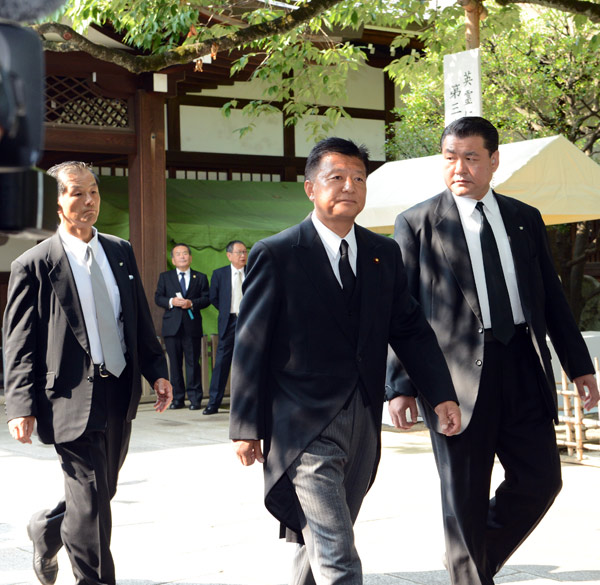
Yoshitaka Shindo (second from right), minister of internal affairs and communications of Japan, arrived at the Yasukuni Shrine in Tokyo on Thursday. Ma Ping / Xinhua |
Dawn broke, shortly after 5 am, over a political heart of darkness. The sun's rays cast an unflattering light on the shadow world of Japanese militarism in its pomp and glory at the Yasukuni Shrine.
The banners, illegally displayed, celebrated past conquest and brutality.
The first parade, and I use the term in a broad sense, as it was hardly a display of martial discipline, passed the two-meter tall sign, halfway up the shrine, at 8:40 am. The sign they passed, under their fluttering radiant sun flags, said in both Japanese and English that military banners, parades and weapons were strictly prohibited.
When it chooses, Japan is one of the most law-abiding societies in the world. On Aug 15, a day of political infamy in Tokyo, it chooses not to enforce the wartime banner law.
These were not old comrades reminiscing in the twilight of their years about battles won and lost, about fate's quirks of benevolence. These were men determined to resurrect and nurture a new generation of militarism.
"We need a strong Japan," one said. "One that can stand on its own."
T-shirts with English writing said "Japan Must Stand Up", code if any was needed for a stronger military. Other T-shirts being sold outside the main gate with the chrysanthemum logo of the shrine came in small and medium sizes.
The first riot police took up position at Kudanshita subway station, the nearest to the shrine, shortly after 6:30 am. The first crowd-control barriers were erected outside the main entrance at 6:40 am. Just before 11 am doves were released and by 11:15 am a fleet of 27 coaches had been parked nearby, bringing in people as if in tour groups.
At 10:36 am the crowd was streaming through the main gate at the rate of more than 100 every minute. A serving military officer and a two-striped sergeant arrived wearing full military uniform, complete with white gloves. Just how they could justify their presence when their head of state dare not visit was something that did not seem to perplex them as they ambled toward the shrine.
A Japanese man, dressed in a Waffen-SS uniform, posed for photographs. "We must fight the good fight," he said.
Stalls did a brisk trade in trinkets, key rings and other mementos. Mothers bought ice cream for their children.
At midday, a minute's silence was observed by most. Right-wing extremists and members of the public bowed their heads.
The Japanese government must bear responsibility. First they allow the shrine to spread its obnoxious propaganda. Also some visitors were there because Tokyo has not yet organized a decent way for members of the general public to acknowledge an historic day, the surrender of Japan. Literally, across the road the emperor and other dignitaries held a formal ceremony. But the general public is excluded. A vacuum exists, one that Yasukuni can exploit.
The air-conditioned museum annex beside the shrine lured thousands with its promise of cool shade. A Zero fighter takes pride of place near the entrance. A cannon from the 100th Artillery Battalion, from Okinawa, the last of its kind according to the plaque underneath it, was of particular interest. Bullet holes were evident, testimony, the plaque said, to the intensity of fighting. The plaque also states that the exhibits on display are there to ensure the peace of the nation, an assertion that would be laughable if it was not so serious. The shrine, oozing menace and militarism, portrays itself as a keeper of peace.
In Japan, Yasukuni is often described as an oasis. True, its tree-lined avenue, meandering paths, do provide a refuge of sorts from the city's frenzy. But it acts like an incubator of a vicious creed.
Nobody is suggesting that Japan will become a military state in the foreseeable future, but the building blocks for such a state are disturbingly visible on the streets of Tokyo - from the schoolboys in their Prussian-style uniforms with brass buttons, to the menacing black sound trucks that blare out nationalist propaganda and to which police turn a deaf ear.
Immediately after World War II, Japan experienced its only time of true liberalization. Trade unions were allowed, political debate and dissent encouraged. But then the US occupation forces became chilled by the Cold War and reversed course. War criminals were rehabilitated and political stability became the watchword. Beliefs that sustained and nourished the extreme right were never challenged, as they were in post-war West Germany.