Comments
  Print
Print  Mail
Mail  Large Medium Small
Endangered green turtles are ingesting more man-made debris, including potentially lethal plastic products, than ever before, a new Australian study has shown.
 |
|
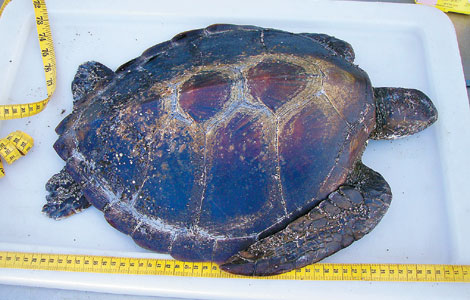
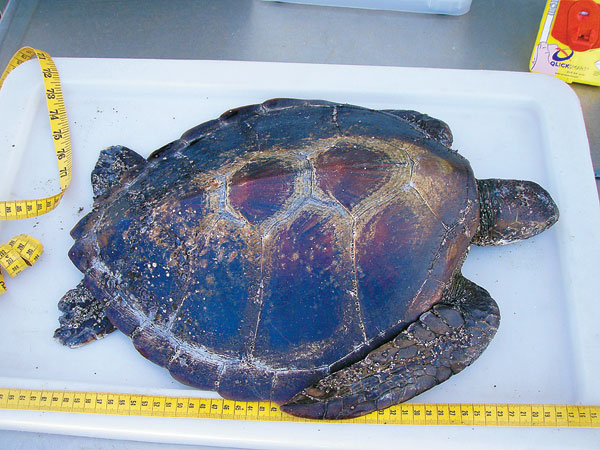
This photo released by University of Queensland shows a green sea turtle after large quantities of marine debris were removed from its body. Kathy Townsend / University of Queensland via AFP |
The majestic turtles are significantly more likely to swallow plastic than they were in the 1980s, according to the study published in the journal Conservation Biology.
The research reviewed scientific literature on the ingestion of man-made rubbish in the ocean by sea turtles published since 1985.
It showed that six of the world's seven species of sea turtles have been found to ingest debris, and all six are listed as globally vulnerable or endangered.
"We found that for green sea turtles, the likelihood that a sea turtle has ingested debris has nearly doubled in the last 25 years," Qamar Schuyler from the University of Queensland, who led the study, said on Friday.
"Specifically for green turtles, it does appear that they are eating a lot more debris than they used to."
The study found that the likelihood of a green turtle, which can grow to 1.5 meters and live for 80 years, ingesting debris jumped from about 30 percent in 1985 to nearly 50 percent in 2012.
The research said it was clear that since the first data was recorded more than 100 years ago, the amount of refuse leatherback turtles had ingested had also increased.
However, between 1985 and 2012 their intake had been stable.
Plastic products eaten by turtles and other marine life can be lethal, killing the animals by either blocking their stomachs and starving them or through puncturing their intestinal system.
Schuyler said ingested plastics could also be releasing toxins into the animals, either through chemicals in the plastics or after products have absorbed toxins in the ocean.
"The animal may not die of that right away but it may affect things like their reproductive cycle and that has longer-term consequences," she said.
Schuyler, a doctoral candidate, said the data showed that turtles washing up with lots of plastic in them were not necessarily found in the most polluted or populated places.
"So it means that they are ingesting that debris usually somewhere farther away from where they end up," she said, adding that this suggested that a global response was needed to counter the problem.
The research, analyzing 37 studies published from 1985 to 2012 that reported on data collected from before 1900 through to 2011, found that turtles in nearly all regions ingested debris, most commonly plastic.
 They are not real babies, but dolls
 California wildfire destroys 26 homes
 Muslims around the world mark end of Ramadan fast
 Giant blanket for royal baby
 Muslims celebrate the end of Ramadan
 Starved polar bear proof climate change deadly
 A house fire broke out in California
 Bengal tiger cub makes its debut in Peru

Copyright 1995 - . All rights reserved. The content (including but not limited to text, photo, multimedia information, etc) published in this site belongs to China Daily Information Co (CDIC). Without written authorization from CDIC, such content shall not be republished or used in any form. Note: Browsers with 1024*768 or higher resolution are suggested for this site.
License for publishing multimedia online 0108263 Registration Number: 20100000002731