Comments
  Print
Print  Mail
Mail  Large Medium Small
|
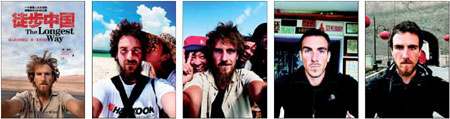
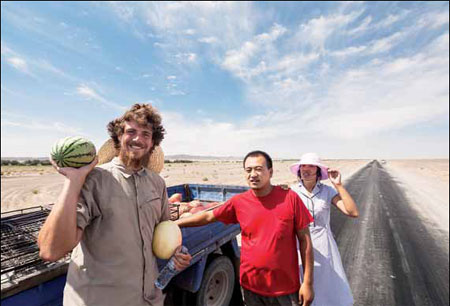
The Chinese version of Christoph Rehage's book The Longest Way, and photos taken during his walking trip from Beijing to Urumqi. Provided to China Daily |
|
Above: While walking through the Gobi desert, Rehage often received watermelons as gifts. Left: Rehage at a coal mine. |
Adventure and heartbreak on hiker's inspirational trip across China
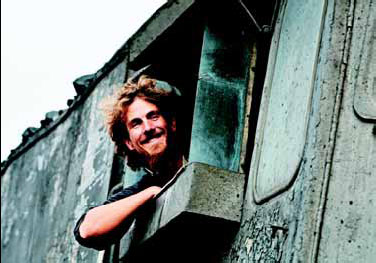
Christoph Rehage stepped out of his apartment in Beijing on his 26th birthday with the romantic notion that he could walk home to Munich, where his girlfriend was waiting.
Carrying a backpack filled with a sleeping bag, two tents, a laptop and a camera, he set off on Nov 9, 2007, intending to take photographs, keep a blog, and grow his beard and hair along the way.
Halfway through the journey when he was in the northwestern city of Urumqi, his plans were halted when his girlfriend called to break off their relationship. Heartbroken, the German cut his long and straggly hair, shaved off his beard, and flew back to Munich to try to pick up the pieces.
All he had from his sojourn across China was a collection of more than 30,000 photos and a blog. Rehage made a video with the photos and posted it online, where it chalked up millions of clicks. As more people became interested, a German publication asked him to write his story.
The Longest Way was published in German, but the author was in Beijing recently to introduce the Chinese edition.
"I had just wanted to record what I saw and felt, and I didn't expect so many people to be interested," says Rehage in a cafe in Beijing, after going online to meet with enthusiastic Chinese netizens.
Xiao Yunke, an editor at China South Booky Culture Media, the publisher that brought his book to the Chinese market, says it sold at least 50,000 copies in the first month.
"Rehage's book is more than a travel journal. It offers a fresh eye on life in China and we are often touched by his encounters," says Cai Jinghui, a Chinese travel writer.
"The lifestyle of the ordinary people has always been neglected, whether in Germany or in China," Rehage says. "But in ordinary life, you can find interesting things and touching moments. I want to record these real and precious moments.
"Sometimes I see a mountain, and wonder what's on the other side. I walked 5 to 10 km there and there is another horizon. I keep seeking what's behind. It doesn't have to be beautiful, but you could always see something new."
Rehage's first walking trip was from Paris to his hometown Hannover in north Germany, when he was 22.
"I walked for three-and-a-half weeks. I was tired, but I felt comfortable, free and cool," he says.
Rehage chose to study Sinology at the University of Munich and went to Beijing in 2005 as an exchange student for one year. He then stayed for another year learning photography, and came up with the idea of walking home.
He walked through bustling cities and isolated villages, across plains and the Gobi desert. He recorded folk customs of different regions, noted details of everyday life, and pondered conversations about village life, environmental pollution, construction and personal relationships.
He looked into the history of Chinese cultural relics and the people's attitude toward them.
He also recorded his feelings spending nights in fields, in old temples and in the beds of hospitable families.
"The most lovable part about walking is, people know you are vulnerable and need help, so they accept and help you. Then you get a chance to enter into their lives," he says.
Rehage says many German readers try to learn about China from his book, but he is very modest about what it could teach them.
"They see something different about China in my book, small cities and villages that have been long neglected. But I won't say it is an objective view about China, only what I experienced around 2008."
Rehage says that many foreigners visit places of interest, such as the Great Wall and the Forbidden City, and then get the feeling that the Chinese are materialists and only out for money.
He recalls when he started walking, he would take all his valuables with him while going to the washroom, thinking they might get stolen.
"In fact, in villages, if you put your bags down, when you come back three hours later, they are still there. Even if they are not, it's probable someone has put them somewhere safe."
While observing people's lives, Rehage also reflected on his own inner world. He was honest about being emotional, shy and scared.
Rehage says it was difficult to start the long journey, but the decision to end halfway was even harder. He went home, continued college in Germany but could not forget China. He continues to share his views and his experiences with about 54,000 fans on Sina Weibo, China's answer to Twitter, every day.
chenyingqun@chinadaily.com.cn

 Filipinos suffer from shortage of typhoon aid
 Healthy baby born to brain-dead mom in Hungary
 Abe honors heroic Chinese student
 Twin panda cubs at Zoo Atlanta
 Hawaii legalizes gay marriage
 Graduation celebration for Santas
 One World Trade Center deemed tallest US skyscraper
 US honors its veterans with ceremonies, parades

Copyright 1995 - . All rights reserved. The content (including but not limited to text, photo, multimedia information, etc) published in this site belongs to China Daily Information Co (CDIC). Without written authorization from CDIC, such content shall not be republished or used in any form. Note: Browsers with 1024*768 or higher resolution are suggested for this site.
License for publishing multimedia online 0108263 Registration Number: 20100000002731