All eyes on sky after hit and near-miss from space


A space rock even bigger than the meteor that exploded like an atom bomb over Russia could drop out of the sky unannounced at any time and wreak havoc on a city. And Hollywood to the contrary, there isn't much the world's scientists and generals can do about it.
But some former astronauts want to give the world a fighting chance.
They're hopeful that Friday's cosmic coincidence - Earth's close brush with a 46-meter asteroid, hours after the 15-meter meteor struck in Russia - will draw attention to the dangers lurking in outer space and lead to action, such as better detection and tracking of asteroids.
"After today, a lot of people will be paying attention," said Rusty Schweickart, who flew on Apollo 9 in 1969, helped establish the planet-protecting B612 Foundation, and has been warning NASA for years to put more muscle and money into a heightened asteroid alert.
 |
|
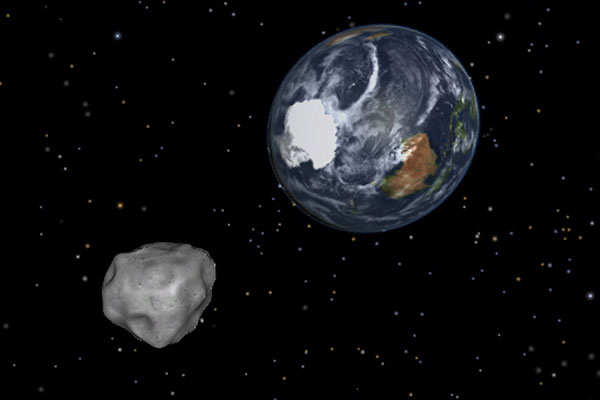
Someformer astronauts say they want to give the world a fighting chance, as the Earth is menaced by meteors. [Photo/Agencies] |
Earth is menaced all the time by meteors, which are chunks of asteroids or comets that enter Earth's atmosphere. But many if not most of them are simply too small to detect from afar with the tools now available to astronomers.
The meteor that shattered over the Ural Mountains was estimated to be 20 times more powerful than the atomic bomb dropped on Hiroshima during World War II. It blew out thousands of windows and left more than 1,000 people injured in Chelyabinsk, a city of 1 million. And yet no one saw it coming; it was about the size of a bus.
"This is a tiny asteroid," said astronomer Paul Chodas, who works in NASA's Near-Earth Object program in Pasadena, California. "It would be very faint and difficult to detect - not impossible, but difficult."
As for the three-times-longer asteroid that hurtled by Earth later in the day on Friday, passing closer to the planet than some communications satellites, astronomers in Spain did not even discover it until a year ago. That would have been too late for pre-emptive action - such as the launch of a deflecting spacecraft - if it had been on a collision course with Earth.
Asteroid 2012 DA14, as it is known, passed harmlessly within 27,599 km of Earth, zooming by at 28,001 km/h, or 8 km per second. Scientists believe there are anywhere from 500,000 to 1 million "near-Earth" asteroids comparable in size to DA14 or bigger out there. But less than 1 percent have actually been spotted. Astronomers have catalogued only 9,600 of them, of which nearly 1,300 are bigger than 0.97 km.
Earth's atmosphere gets hit with 100 tons of junk every day, most of it the size of sand, and most of it burning up before it reaches the ground, according to NASA.
"These fireballs happen about once a day or so, but we just don't see them because many of them fall over the ocean or in remote areas. This one was an exception," NASA's Jim Green, director of planetary science, said of the meteor in Russia.
A 30- to 40-meter asteroid exploded over Siberia in 1908 and flattened 2,137 square kilometers of forest, while the rock believed to have wiped out the dinosaurs 65 million years ago was a monster 9.6 km across.
The chances of Earth getting hit without warning by one of the big ones are "extremely low, so low that it's ridiculous. But the smaller ones are quite different," Schweickart said.
A few years ago, Schweickart and others recommended that NASA launch a $250 million-a-year program to survey asteroids and work up a deflection plan. After 10 years of cataloging, the annual price tag could drop to $75 million, they said.
But "instead of having $250 million a year and working on this actively, NASA now has $20 million," Schweickart lamented. "It's peanuts."
Associated Press
Related stories:
Meteorite-hit Russia proposes common space defense system
Meteorite damage exceeds $30m in Russia
Meteorite hits Russia, 1,200 hurt