Comments
  Print
Print  Mail
Mail  Large Medium Small
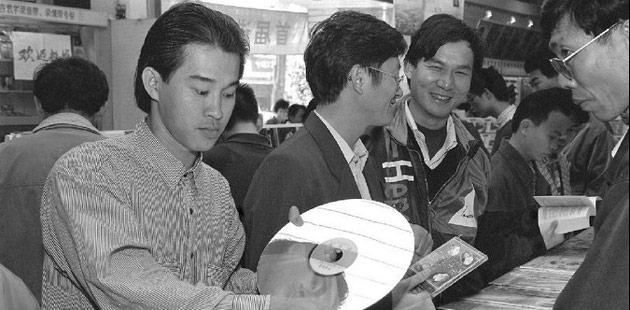
There was a collective sigh of relief, followed by a sense of enthusiasm, when news spread in 1977 that Deng Xiaoping was to return to his former state functions, Boller says.
"I vividly recall the moment when people spontaneously took to the streets to celebrate the event. There was this feeling of awakening after a decade of dire struggle for sheer survival."
Boller says Deng lived up to the expectations of almost everyone he knew at that time as he initiated China's reform and opening- up policy at the third plenary session of the 11th central committee in December 1978.
The policy was to cause momentous changes to Chinese society that are still taking place today, enabling the country to make rapid economic progress.
"And, of course, it was exciting to report about all this as a journalist since China became - and still is - a laboratory of economic and social reforms on a huge scale," Boller says.
"And when I am telling you this, it jumps to my mind that we were probably more curious and less ideological than most of the Western media reporting from China today."
Boller believes the Western media's more critical approach to China today is due to the world's changing balance of economic power.
"So their media takes a tougher stance, emphasizing ideological differences, often with missionary zeal and at the expense of factual and accurate reporting."
He also believes China should be more relaxed with foreign media organizations.
"Let them move around and show them what's really going on in China," he says, adding that most people change their attitude toward the country after visiting it.
Boller suggests that China can argue with the West about its development model and political systems. "There are strong and valid arguments that China should not follow the Western path in all respects."
Democracy and market economics are strong global trends shared by all successful countries, but they can and should vary in form according to historical and cultural contexts, he says.
"This is especially true for a country like China, which is not only a nation but a civilized state setting its own standards. An entity of this size and history cannot simply be built and modernized on borrowed values and institutions. Once the West has understood that, exchange and cooperation should be easier."
Following his stint as a journalist, Boller became vice-president of the Swiss-Chinese Chamber of Commerce and later opened a traditional Chinese medicine business in Switzerland, initiated by Amy Wu.
The couple have traveled in almost every region of China, and their journeys have increased their fascination with the country and particularly with traditional Chinese medicine.
Traditional Chinese medicine is based on Confucian and Daoist philosophies of balance and unity of opposites (yin and yang).
"This is the overarching theory and for years we have been promoting that TCM is an essential part of Chinese culture," Wu says.
Boller and his wife also founded a company called Media Tank in 2007, aimed at fostering understanding between China and the rest of the world.
"For that purpose we intended to create a platform on which opinion leaders from Europe and China can personally meet and discuss an issue of common interest and strategic relevance," Boller says.
Media Tank led to a number of exciting encounters, including one between the editor-in-chief of the French newspaper Le Monde and a former Chinese ambassador to France. Recently, it facilitated a meeting between a German philosopher and a Chinese philosopher.
Boller and his wife have also organized a dialogue with Chinese strategist Zheng Bijian, who pushes for reform and democratization in international relations, and have approached Henry Kissinger, the US elder statesman, who warned in his book On China that if the US and China see themselves as rivals it could lead to catastrophe.
The biggest challenge to both sides, Boller says, is to build "strategic confidence".
"Bilateral relations are of the greatest importance and need more care, and we are devoted to promoting such exchanges."
Contact the writers at fujing@chinadaily.com.cn and xiesongxin@chinadaily.com.cn
(China Daily 01/25/2013 page28)
 Filipinos suffer from shortage of typhoon aid
 Healthy baby born to brain-dead mom in Hungary
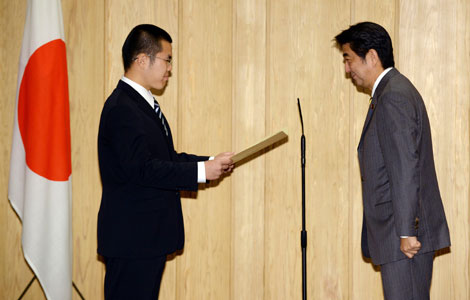 Abe honors heroic Chinese student
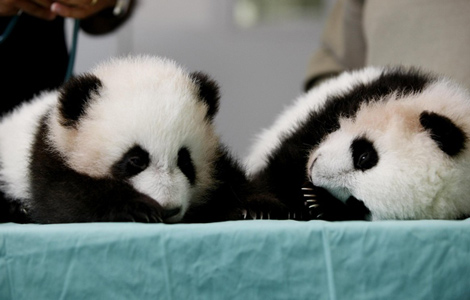 Twin panda cubs at Zoo Atlanta
 Hawaii legalizes gay marriage
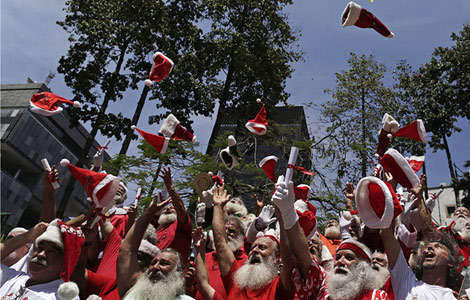 Graduation celebration for Santas
 One World Trade Center deemed tallest US skyscraper
 US honors its veterans with ceremonies, parades

Copyright 1995 - . All rights reserved. The content (including but not limited to text, photo, multimedia information, etc) published in this site belongs to China Daily Information Co (CDIC). Without written authorization from CDIC, such content shall not be republished or used in any form. Note: Browsers with 1024*768 or higher resolution are suggested for this site.
License for publishing multimedia online 0108263 Registration Number: 20100000002731