Comments
  Print
Print  Mail
Mail  Large Medium Small
CAPE CANAVERAL, Fla. - NASA's Kepler space telescope has uncovered another 461 potential new planets, most of which are the size of Earth or a few times larger, scientists said on Monday.
The announcement brings Kepler's head count to 2,740 candidate new worlds, 105 of which have been confirmed.
"Two years ago we had around 1,200 candidate planet objects. A year later, we added a significant number of new objects and saw the trend of huge numbers of very small planets ... twice the size of Earth and smaller," Kepler astronomer Christopher Burke told a news conference webcast from the American Astronomical Society conference in Long Beach, California.
|
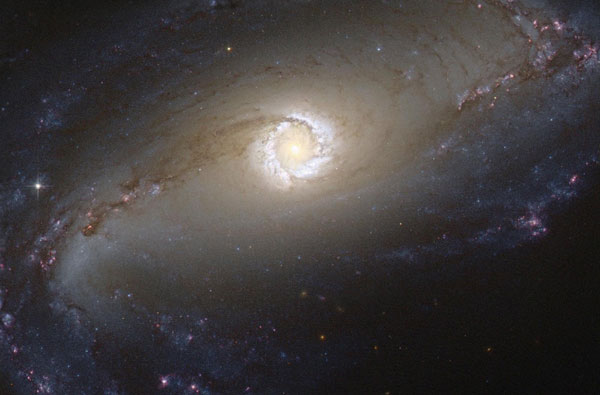 This NASA/ESA Hubble Space Telescope image shows the bright star-forming ring that surrounds the heart of the barred spiral galaxy NGC 1097, a Seyfert galaxy. The larger-scale structure of the galaxy is barely visible. Its comparatively dim spiral arms, which surround its heart in a loose embrace, reach out beyond the edges of this frame. This face-on galaxy, lying 45 million light-years away from Earth in the southern constellation of Fornax (The Furnace), is particularly attractive for astronomers. [Photo/Agencies] |
With the addition of 461 new candidate planets, collected over 22 months of Kepler telescope observations, the proliferation of smaller planets continues.
The new targets include what appears to be a planet about 1.5 times bigger than Earth circling its sun-like parent star in a 242-day orbit - a distance where liquid water, believed to be necessary for life, could exist on its surface.
In related research, astronomers have determined that about one in six sun-like stars have Earth-sized planets circling their parent stars closer than Mercury's 88-day day orbit around the sun.
The goal of the Kepler mission, which began in 2009, is to determine how many stars in the Milky Way galaxy have an Earth-sized planet orbiting in so-called habitable zones, where water can exist on its surface.
"You need very specific conditions to have liquid water. You can't have your planet too close to your star where it's too hot. You can't have it too far away for the planet conditions to be too cold. We're trying to find these planets in this very specific habitable zone," said Burke, who is with the SETI Institute in Mountain View, California.
The Kepler telescope works by tracking slight decreases in the amount of light coming from 160,000 target stars caused by a planet or planets passing by, or transiting, relative to the telescope's point of view.
Earth-sized planets located about where Earth orbits the sun would take 365 days to circle their parent star. Those located closer, in Mercury-like 88-day orbits, transit more frequently.
Scientists need at least two and preferably three or more cycles to determine whether an apparent transit is real or some other phenomena.
"In order to catch several transits of an Earth analog, you have to wait for one more year to get another transit. It's simply too early to call," said astronomer Francois Fressin, with the Harvard-Smithsonian Center for Astrophysics.
The Kepler roster also boosts the number of multi-planet systems. Of the 2,740 objects, 299 are in dual-planet systems, 112 are in triplets, 44 are part of four-planet systems, 11 systems have five planets and one system has six planets.
Copyright 1995 - 2010 . All rights reserved. The content (including but not limited to text, photo, multimedia information, etc) published in this site belongs to China Daily Information Co (CDIC). Without written authorization from CDIC, such content shall not be republished or used in any form. Note: Browsers with 1024*768 or higher resolution are suggested for this site.
License for publishing multimedia online 0108263 Registration Number: 20100000002731