Comments
  Print
Print  Mail
Mail  Large Medium Small
Few firms are investing the resources needed to achieve their goals in tough environment
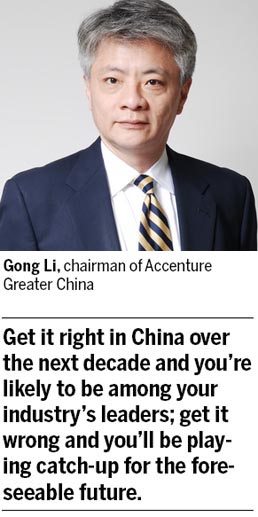
Multinational companies that do not commit the resources required to succeed in this complex and challenging market may be jeopardizing their future global position.
Most multinational companies have recognized China's long-term strategic importance and laid out ambitious plans for the market.
However, the challenge comes in matching ambition with action.
In our experience, few companies are committing the resources required to achieve their lofty goals in this complex and challenging market.
|
 |
Why? For many companies, with deep roots in developed markets, growth in China presents a dilemma: With the lion's share of the revenue still generated in the United States and Europe, it's difficult to divert investment dollars and management time to China.
How can companies overcome the China challenge?
Much of the answer lies in "positive discrimination" - that is, in directing a disproportionate amount of investment and management time to China.
Based on Accenture's work with multinationals entering and operating in China, we believe that answering five questions will help MNCs determine what they need to do to make the country a top priority.
1. How many of our senior leaders are based in China?
Adaptation is crucial in this complex market: Your business model, products and services, and operations must be tailored for China.
To make the necessary adjustments, you'll need some of your best people and the ones making the decisions on the ground.
This is the only way senior leadership will come to grips with the nuances of doing business in China and be able to respond quickly to this fast-evolving market.
This is not to say that you should rely solely on expats to run your operations in China.
Building a strong local leadership team is vital, given the importance of local knowledge and relationships.
However, moving some experienced leaders to China will be necessary and unavoidable, particularly given the competition for top managerial talent in the country.
Yet it shouldn't be just the leaders of your Chinese or Asian operations who spend an extended period of time in the country.
If you see China as a significant part of your future business, anyone aspiring to run a global business unit or function should spend time there, learning the dynamics of the market.
Aside from relocating senior leaders to China, some companies are using innovative approaches to give their top team greater exposure to the country.
Starwood Hotels & Resorts Worldwide is a good example. In 2011, rather than holding occasional ad hoc meetings in China, the company moved its eight-member leadership team to Shanghai for one month.
2. Does the head of our China business report directly to the CEO?
Given how fast most industries are growing and evolving in China, responsiveness can be an important competitive advantage for a Western company.
Yet in many multinationals, two, three, sometimes even four reporting layers separate the senior China executive from the CEO.

 US honors its veterans with ceremonies, parades
 Carnival season kicks off in Cologne
 Typhoon Haiyan hits Vietnam
 UK's Royal Air Force marks ties with Bahrain
 Red Cross Red Crescent holds meetings in Sydney
 Intl space crew returns Olympic torch to Earth
 Philippines storm kills estimated 10,000
 Games of Indigenous People kicks off in Brazil

Copyright 1995 - . All rights reserved. The content (including but not limited to text, photo, multimedia information, etc) published in this site belongs to China Daily Information Co (CDIC). Without written authorization from CDIC, such content shall not be republished or used in any form. Note: Browsers with 1024*768 or higher resolution are suggested for this site.
License for publishing multimedia online 0108263 Registration Number: 20100000002731