Forestry, farming and mining reap rewards
Updated: 2012-06-29 08:07
(China Daily)
|
|||||||||||


|
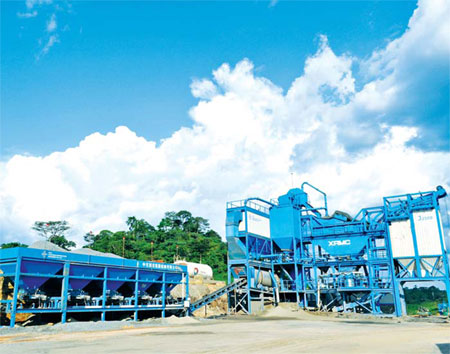
Mining offers excellent opportunities for investors looking for rich returns. Photos Provided to China Daily |
Investment in three important sectors will see Congo's economy soar in the coming years
Private investment in Congo, driven by the oil and telecoms sectors, increased by 4 percent in 2011, and the country is keen to attract more.
While the strongest potential is in forest activities, agriculture, livestock rearing, fishing, mining and hydrocarbons, there are also buoyant opportunities within the industrial sectors such as food processing, timber and construction.
Poor infrastructure and flawed legal, financial and administrative systems may have hampered investments in the past, government officials are tackling the challenges head-on in an effort to engage more private sector investors. One move is the creation of the High-Level Council for Public-Private Dialogue, under the President's jurisdiction, which will bring together representatives of the private sector, the administration and the public sector.
Agriculture is one of the most promising areas for investment. Despite having more than 12 million hectares of land available for farming, Congo imported foodstuffs to the value of 198 million euros ($251 million) last year.
The government believes more than 20,000 jobs could be created from plantations developed in the prime areas between Cuvette in the north and Sangha in the north-west.
With around 65 percent of Congo territory covered in woodlands, forestry plays an important role within the economy. More than 80 percent of the total forest area is considered good for commercial purposes and the government is keen to balance that potential with a commitment to a green economy.
Today, 3.5 million of the 22 hectares covered are protected and 2.5 million hectares have been eco-certified by the Forest Stewardship Council.
President Sassou N'Guesso was the first Congo President to impose a restriction on log exports. In 1997, he adopted a policy stressing that 60 percent of the logs cut down should be processed and treated within the country.
That is now up to 85 percent, and as a result, international companies are required to invest in factories and to hire and train the local workforce, thereby adding value to the Congolese economy.
Responsible planting
After public services, the forestry sector is the biggest employer and a total of 41 production units have been set up or renovated including sawmills, molding, and plywood. There are three industrial cabinet making and woodwork factories.
A program is now underway to rapidly develop education centers that can train a responsible workforce within the sector.
There are currently 30 companies specializing in Congo's timber industry, and more than half of them are foreign.
China provides the leading market for wood exports, followed by the European Union, and most products are shipped through Pointe Noire port. Today, Congo has 73,000 hectares of commercial plantations 19,000 of which will be dedicated to sustainable production in the future.
Last year, Congo and the EU signed a partnership to combat illegal forest exploitation, which stated that from July, any cargo of wood entering the EU from Congo must have authorization testifying its legal origins.
The creation of these plantations will provide much-needed jobs in the rural sector, and, the government hopes, put an end to the illegal wood commerce that exists.
Congo's registered forests are either on State Forestry property or private property. Public sites are organized into Forest Development Units, the commercial part of which is ensured by people with deeds delivered by forest authorities.
Agreements are given through a tendering process and concessionaries must demonstrate their development programs and collaborate with the forest administration services on sustainable development principles.
Nine such agreements have so far been allocated to the big forestry companies working in the north and to one in the south. About 18 forestry concessions, covering almost six million hectares - about 55.65 percent of the total area allocated for forestry exploitation - will have a development program.
Education points
Forest dwellers are still prone to killing wild apes, thereby flouting the 1996 Lusaka agreement which forbids the commerce of wild animals and fauna, in order to earn money.
The Service National des Produits Forestiers l'Exportation has been set up to monitor the wood products entering and leaving Congo, ensuring the legal origin of the product. "Although this goes some way to fighting poaching, it is hard to change these peoples' mentalities," the president said.
"Education is a big part of the fight and some NGOs have been drafted in to protect the apes and offer a unique experience to the locals and visitors within the framework of eco-tourism."
Congo's registered forests are either on State Forestry property or private property. Public sites are organized into Forest Development Units, the commercial part of which is ensured by people with deeds delivered by forest authorities.
Agreements are given through a tendering process and concessionaries must demonstrate their development programs and collaborate with the forest administration services on sustainable development principles.
Nine such agreements have so far been allocated to the big forestry companies working in the north and to one in the south. About 18 forestry concessions, covering almost six million hectares - about 55.65 percent of the total area allocated for forestry exploitation - will have a development program.
Mining prospects
Mining is another sector wide open for investment, and production in recent years has far exceeded expectation, with most minerals going to China and Germany.
The Congolese government owns 10 percent of the capital of any mining company operating there and it is slated to become a mining operator in its own right in the coming years.
With riches such as diamond, gold, cooper, lead, zinc, iron ore, magnesium and potash, international companies have been keen to enter the country and the government has made it clear there is much scope for more development, exploration and exploitation. Not surprisingly, it is the sector that attracts most FDI.
Mining legislation is directed by the Mining Code which supervises all stages of the operations. The code has reinforced and liberalized the sector to allow more foreign investors in to what has for years been accomplished by small-scale domestic operations.
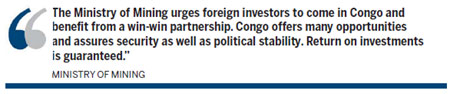
Many procedures have been simplified and facilitated in a bid to encourage those companies, including decreased taxation and greater transparency within the sector. The Ministry of Mines is proud to note that the mining sector, like every other sector in Congo, offers a risk-free investment environment.
Mining has done much in terms of job creation. In its development stage, for example, MPD, which is exploring the Zanaga mine, is hiring 1,000 workers, and will hire 14,000 more for the production process.
Three Chinese companies are already involved in gold and diamond mining, namely Zhong Jun Hui Da Beijing Investment Co, Million Well Holdings, and Congo Yuan Wang Investment.
Micro-financing
In its keenness to help local entrepreneurs, the government has introduced micro-financing and improved credit access facilities. The Ministry of Mines is also addressing the skills issue by running training programs and seminars to improve local investment and encourage foreign investment.
Companies benefiting from this included MagMinerals Potasses Congo which obtained its permit back in 2008 and invested more than $47,8 million for building infrastructures in the aim of starting exploitation at the end of 2011.
However, affected by the financial crisis, the company sought new partners and in 2011, Evergreen Resource Holdings, a Chinese company, took over 77 percent of MagMinerals' capital.
InFocus provided the story
(China Daily 06/29/2012 page8)




Hot Topics
China has welcomed the adoption of a UN Security Council resolution on Syria, saying it reflected the unity of the council.
Editor's Picks

|
|

|
|

|

|