Launch and recovery of aircraft
Updated: 2011-07-22 11:06
(Agencies)
|
|||||||||||


|
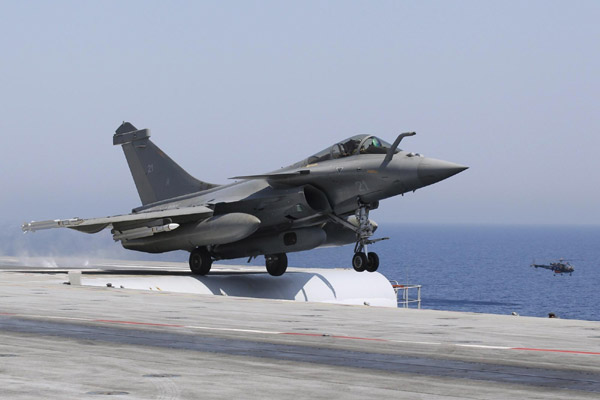 A Rafale fighter jet makes a catapult launch on the flight deck, where in two seconds the jet goes from 0 to 250 kms per hour, aboard France's flagship Charles de Gaulle aircraft carrier March 28, 2011.?[Photo/Agencies] |
As "runways at sea," modern aircraft carriers have a flat-top deck design that serves as a flight deck for the launch and recovery of aircraft. Aircraft are launched in a forward direction, into the wind, and recover from astern. Carriers steam at speed, for example up to 35 knots (65 km/h), into the wind during flight deck operations in order to increase the wind over the deck to exceed a safe minimum. This increase in effective wind speed provides a higher launch airspeed for aircraft at the end of the catapult stroke or ski-jump, plus it makes recovery safer by reducing the difference between the relative speeds of the aircraft and ship.
On conventional carriers, a steam-powered catapult is used to accelerate the aircraft to a safe flying speed by the end of the catapult stoke after which the aircraft is airborne and further propulsion is provided by its own engines. On other modern carriers, aircraft do not require catapult assistance for take off, instead an upwards vector is provided by a ski-jump at the forward end of the flight deck. Which form of assistance provided is dependent on aircraft design and performance and is part of the overall design of the carrier and aircraft as a system.
|
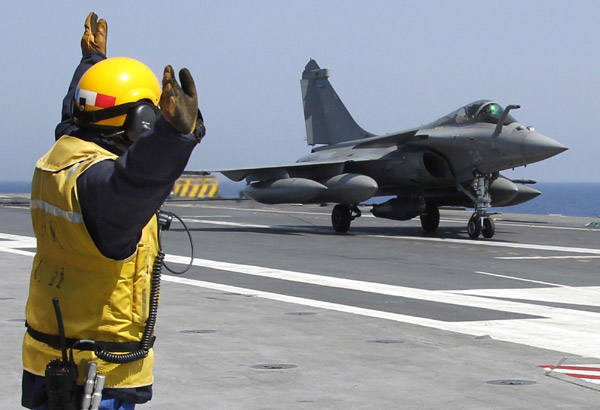 A Rafale fighter jet returns from a mission on the flight deck of France's flagship Charles de Gaulle aircraft carrier March 27, 2011. [Photo/Agencies]? |
Conversely, when recovering onto a carrier, conventional aircraft rely upon a tailhook that catches on arrestor wires stretched across the deck to bring them to a stop in a short distance. Helicopters and V/STOL (Vertical/Short Take-Off and Landing) aircraft usually recover by coming abreast the carrier on the port side and then using their hover capability to move over the flight deck and land vertically without the need for arresting gear.
Conventional ("tailhook") aircraft rely upon a landing signal officer (LSO, sometimes called "paddles") to monitor the plane's approach, visually gauge glideslope, attitude, and airspeed, and transmit that data to the pilot. Before the angled deck emerged in the 1950s, LSOs used colored paddles to signal corrections to the pilot (hence the nickname). From the late 1950s onward, visual landing aids such as optical landing system have provided information on proper glide slope, but LSOs still transmit voice calls to approaching pilots by radio.
To facilitate working on the flight deck of a US aircraft carrier, the sailors wear colored shirts that designate their responsibilities. There are at least seven different colors worn by flight deck personnel for modern United States Navy carrier air operations. Carrier operations of other nations use similar color schemes.
The disadvantage of the ski-jump is the penalty it exacts on aircraft size, payload, and fuel load (and thus range): large, slow planes such as the E-2 Hawkeye and heavily laden strike fighters like the F/A-18E/F Super Hornet and Sukhoi Su-33 cannot successfully launch using a ski-jump because their high loaded weight requires either a longer takeoff roll than is possible on a carrier deck, or catapult assistance, although the Su-33 does launch with a light fuel and weapons load from a ski jump.