Science and Health
Black hole shreds star, sparking gamma ray flash
(Agencies)
Updated: 2011-06-17 06:35
 |
Large Medium Small |
|
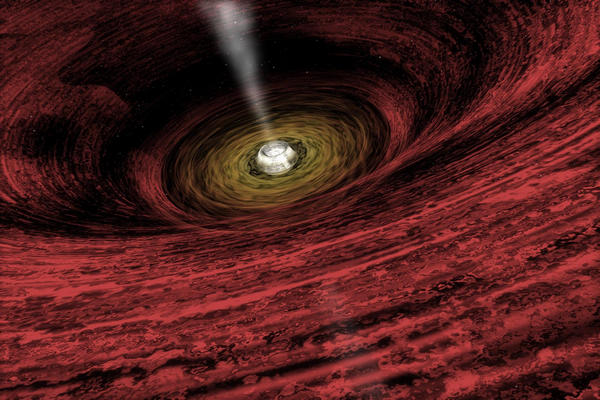 An artist's impression of a growing supermassive black hole located in the early Universe is seen in this NASA handout illustration released on June 15, 2011. Using the deepest X-ray image ever taken, astronomers found the first direct evidence that massive black holes were common in the early universe. This discovery from NASA's Chandra X-Ray Observatory shows that very young black holes grew more aggressively than previously thought, in tandem with the growth of their host galaxies. [Photo/Agencies] |
WASHINGTON - A monster black hole shredded a Sun-like star, producing a strangely long-lasting flash of gamma rays that probably won't be seen again in a million years, astronomers reported on Thursday.
That is definitely not the norm for gamma ray bursts, energetic blasts that typically flare up and end in a matter of seconds or milliseconds, often the sign of the death throes of a collapsing star.
"This is truly different from any explosive event we have seen before," said Joshua Bloom of the University of California-Berkeley, a co-author of research on the blast published in the journal Science.
Initially spied on March 28 by NASA's Swift spacecraft, which is trolling the universe for gamma ray bursts, this particular flash has lasted more than two months and is still going on, Bloom said in a telephone interview.
What makes this even stranger is that the black hole, located in the constellation Draco (The Dragon) about 4 billion light years, or 24 trillion miles (38.62 trillion km) from Earth, was sitting quietly, not eating much, when a star about the mass of our Sun moved into range.
"We have this otherwise dormant black hole, not gobbling up an appreciable amount of mass, and along comes this star which just happens to be on some orbit which puts it close to the black hole," Bloom said.
FEEDING FRENZY
"This was a black hole which was otherwise quiescent and it sort of has an impulsive feeding frenzy on this one star," he said.
Bloom figures this may happen once per black hole per million years.
This kind of behavior is different from what active black holes generally do, which is to suck in everything their vast gravity can pull in, even light. Most galaxies, including our Milky Way, are thought to harbor black holes in their hearts.
Black holes are invisible, but astronomers can infer their existence because the material they pull in lights up before it gets sucked in.
In this case, though, the black hole feasted on one star - about the same mass as our Sun -- with such relish that it tore the star apart before gulping it down. As it did so, the black hole emitted powerful gamma ray jets from its center as bits of the dying star were turned into energy.
| 分享按鈕 |