Asia-Pacific
After 3 months, anti-nuke protests in Japan
(Agencies)
Updated: 2011-06-11 18:24
 |
Large Medium Small |
|
|
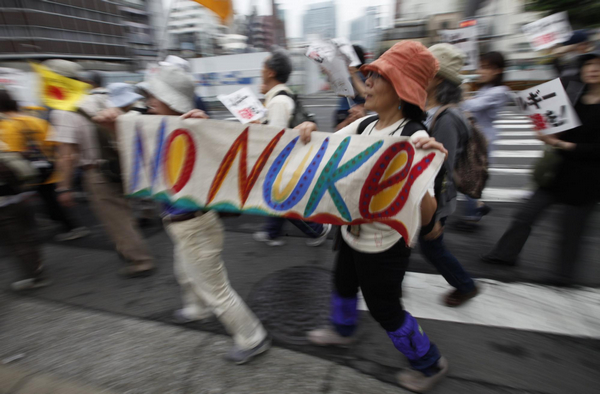
TOKYO - Thousands of anti-nuclear protesters marched in Japan on Saturday, the three-month anniversary of an earthquake and tsunami that triggered the worst nuclear disaster in 25 years, pressing the government to cut the country's reliance on atomic power.
Three reactors went into meltdown after the massive quake hit the Fukushima Daiichi plant in northeastern Japan, forcing some 80,000 of residents to evacuate from its vicinity as engineers battled radiation leaks, hydrogen explosions and overheating fuel rods.
Company workers, students and parents with children on their shoulders rallied at multiple demonstrations across Japan, venting their anger at the government's handling of the crisis, carrying flags written with "No Nukes!" and "No More Fukushima".
"If they don't get the message now, what else has to happen before we stop using atomic energy which has proved so dangerous?" said kindergarten worker Yu Matsuda, 28.
She brought her two- and four-year old children to protest together in front of the headquarters of the operator of the plant, Tokyo Electric Power Corporation (Tepco) .
"I want my children to play outside safely and swim in our sea without any worries," Matsuda said, listening to speeches by civil rights activists and survivors from the tsunami-affected areas.
The protests are likely to add to public pressure that caused a shutdown of the Hamaoka nuclear plant in May and delays to the restarts of reactors across the country after scheduled maintenance until tighter safety measures are put in place.
Currently, Japan is running only 19 of 54 reactors in operation before of the disaster at the Fukushima Daiichi plant, raising the risk of serious power shortages into 2012. Many experts say economic risks are too high for Japan to pull the plug on all of its reactors.
Analysts say the industry is facing more power rationing and the need for energy imports levies a high price on the world's third-largest economy, as Japan lacks the electricity generation capacity to substitute for the nuclear fleet.
"The nuclear lobby says the cost of green energy is too high. But I say the cost of cleaning up this mess and the possibility of more such accidents at the expense of our lives is much higher," said entrepreneur Yonosuke Sawada, 59.
"STOP INFIGHTING"
Angry protesters, shouting "Tepco liars!" and "Give us our friends back!" also criticised the government for its handling of the disaster, which left more than 23,000 dead or presumed dead and laid waste to a broad swathe of the northeast.
Embattled Prime Minister Naoto Kan, who on Saturday visited quake-affected areas to commemorate the victims of the disaster, last week survived a no-confidence vote by saying he would step down when the worst of the crisis was over.
That fuelled uncertainty about the smoothness and the speed of recovery as there is still no agreement on how to pay for Japan's biggest reconstruction project since the years after World War Two.
"It's not a matter of what political party you support. Fukushima is still emitting radiation and politicians should concentrate on ending the crisis - not infighting," said a company worker Jun Miyakawa, 43, sporting a hat in a shape of an exploded reactor building.
Japan's anti-nuclear movement, small and ignored by the general public until the Fukushima crisis, has become more vocal, gathering increasing numbers of people to anti-nuclear demonstrations.
But the numbers of participants in Japan, a conservative society that values cooperation over outcries of public anger, are much smaller than in Germany, where as many as 200,000 protesters pressed the government to completely overhaul its nuclear policies.
Voters have generally supported the role of nuclear energy and even after the accident remained divided over whether all of the nuclear power plants should be closed, polls showed.
"People in Japan do have opinions, but are not used to expressing them in public like the Germans," said Reo Komazawa, 39. "I came here with my friends to play music and to show through music we are anti-nuke," he said as a colourful group of musicians and dancers marched on in the crowd of protesters.
| 分享按鈕 |