Science and Health
First Mercury images in orbit show lots of craters
(Agencies)
Updated: 2011-03-31 08:05
 |
Large Medium Small |
|
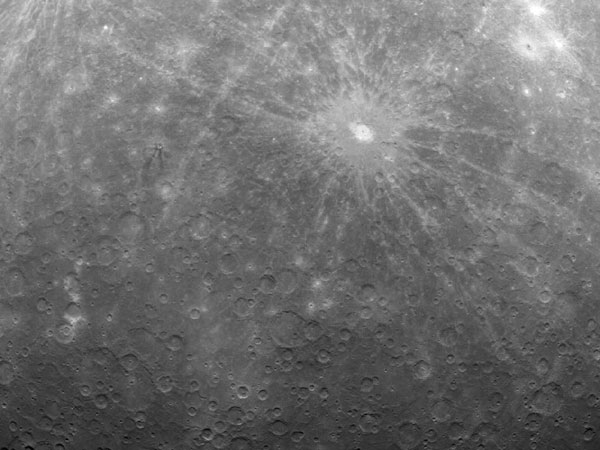 At 5:20 am EDT on Mar 29, 2011, MESSENGER captured this historic image of Mercury. This image is the first ever obtained from a spacecraft in orbit about the Solar System's innermost planet. [Photo/NASA] |
NASA's Messenger spacecraft, which began orbiting the planet less than two weeks ago, reveals a pock-marked planet full of craters from pieces of asteroids and comets.
"Mercury has had an exposed surface for at least 3.5 to 4 billion years and some of those surfaces are extremely cratered to the point where there are so many craters they start to obscure one another," said mission chief scientist Sean Solomon.
He said it was surprising how many secondary craters there are. Those are craters created by the falling soil kicked up from space rock collisions.
Those initial space rock crashes "throw out a lot of material in the explosive process," Solomon said.
One area of the far north of Mercury had never been seen by previous spacecraft on mere fly-bys. The new images show scatterings of secondary craters, almost like a loaded pizza, but not the primary crater that was first carved out. The region is also so far north that the sun barely gets above the horizon and casts long shadows.
"It's heavily cratered," Solomon said Wednesday. "It may have happened on a particularly bad day."
The secondary craters usually are six miles wide but can be as much as 15 miles wide, much larger than secondary craters on the moon, Solomon said.
He said that could be because the chunks of asteroids and comets are moving faster as they get closer to the gravitational pull of the sun so they smack Mercury harder, causing the soil to bounce higher and make bigger secondary craters. The fact that Mercury, unlike the moon, is shrinking and has a magnetic field could be another factor.
Mercury is also darker and appears more weather-beaten than the moon, because of "the constant bombardment of the surface by dust particles and small meteoroids," Solomon said.
Messenger has been circling Mercury only since March 17. In its first day of photo transmission, the space probe sent back 224 pictures, Solomon said. By the end of this week, NASA will have received more than 15,000 pictures from the $446 million spacecraft.
The first imaged offered a glimpse of the planet's dark, frigid south pole, where scientists think there may be ice. But the photo isn't close enough to tell if radar images from Earth that hint at ice are correct, Solomon said. Photos of the poles are scheduled for later in the mission.
Messenger will spend at least a year circling Mercury and start mapping the planet on Monday, eventually crashing into the planet when the mission is over.
Mercury and Messenger are about 66 million miles (106.21 million kilometers) from Earth.
| 分享按鈕 |