Science and Health
Scientist: 'Alien' life forms found on meteorites
By Deborah Zabarenko (China Daily)
Updated: 2011-03-08 10:50
 |
Large Medium Small |
 |
|
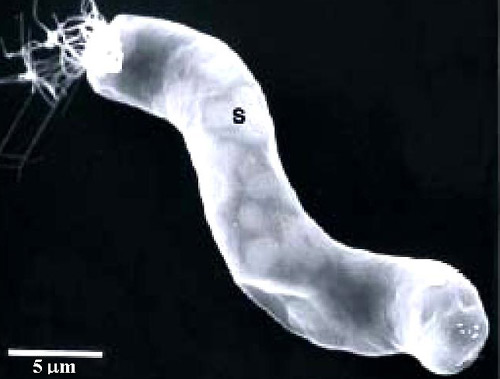
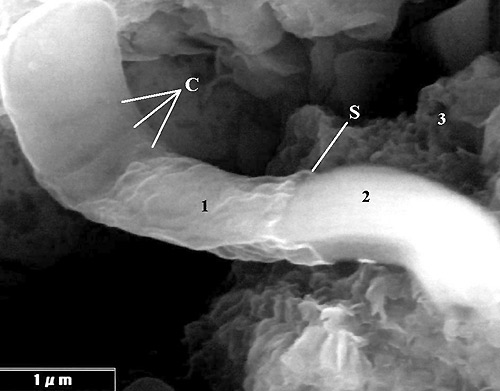
A giant bacterium Titanospirillum velox is seen in a microscopic image released on March 7, 2011 in comparison to meteorite filaments (photo below) in a study published by The Journal of Cosmology which claimed tiny fossilized bacteria had been found on three meteorites. [Photo/Agencies] |
 |
|
A meteorite filament is seen through a microscope image released on March 7, 2011. [Photo/Agencies] |
WASHINGTON - A NASA scientist reported detecting tiny fossilized bacteria on three meteorites and maintains these microscopic life forms are not native to Earth.
If confirmed, this research would suggest life in the universe is widespread and life on Earth may have come from elsewhere in the solar system, riding to our planet on space rocks like comets, moons and other astral bodies.
| ||||


The central claim of the study by astrobiologist Richard Hoover is that there is evidence of microfossils similar to cyanobacteria - blue-green algae, also known as pond scum - on the freshly fractured inner surfaces of three meteorites.
These microscopic structures had lots of carbon, a marker for Earth-type life, and almost no nitrogen, Hoover said.
Nitrogen can also be a sign of Earth-type life, but the lack of it only means that whatever nitrogen was in these structures has decomposed out into a gaseous form long ago, Hoover said.
"We have known for a long time that there were very interesting biomarkers in carbonaceous meteorites and the detection of structures that are very similar ... to known terrestrial cyanobacteria is interesting in that it indicates that life is not restricted to the planet Earth," Hoover said.
Hoover, based at NASA's Marshall Space Flight Center in Alabama, has specialized in the study of microscopic life forms that survive extreme environments such as glaciers, permafrost and geysers.
He is not the first to claim discovery of microscopic life from other worlds.
In 1996, NASA scientists presented research indicating a 4-billion-year-old meteorite found in Antarctica carried evidence of fossilized microbial life from Mars.
The initial discovery of the so-called Mars meteorite was greeted with acclaim and the rock unveiled at a standing room-only briefing at NASA headquarters in Washington.
Since then, however, criticism has surrounded that discovery and conclusive proof has been elusive.
Hoover's research may well meet the same fate. In a statement published with the online paper, the Journal of Cosmology's Editor-in-Chief Rudy Schild said: "Dr Richard Hoover is a highly respected scientist and astrobiologist with a prestigious record of accomplishment at NASA. Given the controversial nature of his discovery, we have invited 100 experts and have issued a general invitation to over 5,000 scientists from the scientific community to review the paper and to offer their critical analysis."
Reuters
| 分享按鈕 |