Science and Health
Early X'mas treat: 2010's total lunar eclipse
(Agencies)
Updated: 2010-12-20 08:24
 |
Large Medium Small |
LOS ANGELES?- Weather permitting, sky gazers in North and Central America and a tiny sliver of South America will boast the best seats to this year's only total eclipse of the moon just days before Christmas.
|
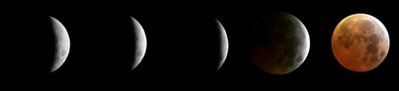 FILE - This five picture combination shows various stages of a total lunar eclipse over Baghdad, Iraq, between 1:30-2:30 am local time on March 4, 2007. Weather permitting, skygazers in North and Central America and a tiny sliver of South America will boast the best seats to this year's only total eclipse of the moon, scheduled for Dec 20, 2010. [Photo/Agencies] |
The eclipse will happen Monday night on the West Coast and during the wee hours Tuesday on the East Coast. Western Europe will only see the start of the spectacle while western Asia will catch the tail end.
| ||||


Since the eclipse coincides with winter solstice, the moon will appear high in the sky?-- a boon for skywatchers. With recent volcanic eruptions around the globe dumping tons of dust into the atmosphere, scientists predict the moon may appear darker than usual during the eclipse, glowing an eerie red or brown instead of the usual orange-yellow tinge.
North and Central America should be able to view the entire show, which is expected to last 3 hours and a half if skies are clear. Total eclipse begins at 11:41 pm PST Monday or 2:41 am EST (0741 GMT) Tuesday. The totality phase?-- when the moon is entirely inside Earth's shadow?-- will last a little over an hour.
"It's perfectly placed so that all of North America can see it," said eclipse expert Fred Espenak of NASA's Goddard Space Flight Center.
The Griffith Observatory perched on the south slope of Mount Hollywood in Los Angeles will host an eclipse party Monday evening although rain is forecast. Telescopes will be set out on the lawn for the public and astronomers will give free lectures on the eclipse's various stages.
If clouds or rain set in, the observatory plans to stream live video of the eclipse from the Internet. Among the various outfits that will show the eclipse live is NASA, which has a camera mounted at its Marshall Space Flight Center in Huntsville, Alabama.
"Our event will go on rain or shine," said Griffith Observatory astronomer Anthony Cook.
Unlike solar eclipses which require protective glasses, lunar eclipses are safe to watch with the naked eye.
US Naval Observatory spokesman Geoff Chester finds solar eclipses more exciting than the lunar counterpart. But solar eclipses tend to occur in remote parts of the world while lunar eclipses are usually visible from an entire hemisphere.
"If you get skunked by bad weather, all you have to do is wait a few years for the next one to come around," Chester said.
There will be two total lunar eclipses in 2011?-- in June and December. North America will miss the June show and witness only a part of next December's eclipse.