Science and Health
Arsenic-munching germ redefines 'life as we know it'
(Agencies)
Updated: 2010-12-03 10:58
 |
Large Medium Small |
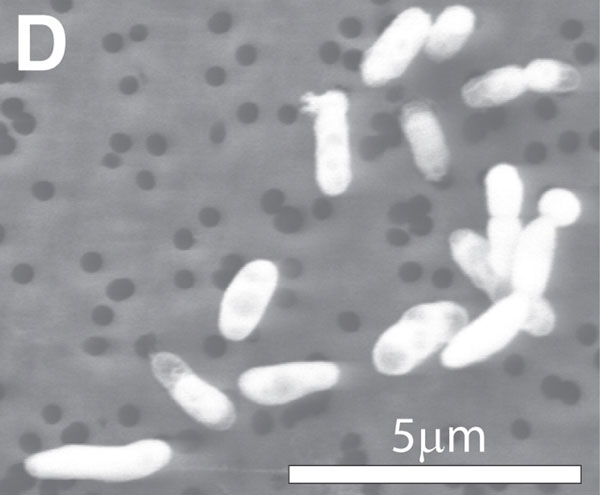
The bacterium strain GFAJ-1 is seen in this scanning electron micrograph image shown in an undated photograph released by NASA, the journal Science and the American Association for the Advancement of Science on Dec 2, 2010. [Photo/Agencies] |
The bacteria do not merely eat arsenic - they incorporate the toxic element directly into their DNA, the researchers said.
The finding shows just how little scientists know about the variety of life forms on Earth, and may greatly expand where they should be looking for life on other planets and moons, the NASA-funded team said.
"We have cracked open the door to what is possible for life elsewhere in the universe," Felisa Wolfe-Simon of the NASA Astrobiology Institute and US Geological Survey, who led the study, told a news conference.
The study, published in the journal Science, demonstrates that one of the most notorious poisons on Earth can also be the very stuff of life for some creatures.
Wolfe-Simon and colleagues found the strain of Halomonadaceae in California's Mono Lake, formed in a volcanic region and very dense in minerals, including arsenic.
The lake is teeming with life, but not fish. It also contains the bacteria.
"Life is mostly composed of the elements carbon, hydrogen, nitrogen, oxygen, sulfur and phosphorus," the researchers write in Science.
These six elements make up the nucleic acids -- the A, C, T and G of DNA -- as well as proteins and lipids. But there is no reason in theory why other elements should not be used. It is just that science never found anything alive that used them.
The researchers grew microbes from the lake in water loaded with arsenic, and only containing a little bit of phosphorus.
Scientists amazed
The GFAJ-1 strain of the Halomonadaceae grew when arsenic was in the water and when phosphorus was in the water, but not when both were taken away. And it grew even with "double whammy" of arsenic.
"It grew and it thrived and that was amazing. Nothing should have grown," Wolfe-Simon told a news conference.
"We know that some microbes can 'breathe' arsenic, but what we've found is a microbe doing something new -- building parts of itself out of arsenic."
Paul Davies of NASA and Arizona State said the bacterium is not a new life form.
"It can grow with either phosphorous or arsenic. That makes it very peculiar, though it falls short of being some form of truly 'alien' life belonging to a different tree of life with a separate origin," he said.
But it does suggest that astrobiologists looking for life on other planets do not need to look only for planets with the same balance of elements as Earth has.
"Our findings are a reminder that life-as-we-know-it could be much more flexible than we generally assume or can imagine," said Wolfe-Simon.
"If something here on Earth can do something so unexpected, what else can life do that we haven't seen yet? Now is the time to find out."
James Elser, an expert on phosphorus at Arizona State University, said such bacteria may be useful for generating new biofuels that do not requite phosphate fertilizers, treating wastewater or cleaning up toxic waste sites.