Science and Health
Just found: The planet from another galaxy
(Agencies)
Updated: 2010-11-20 15:25
 |
Large Medium Small |
 |
|
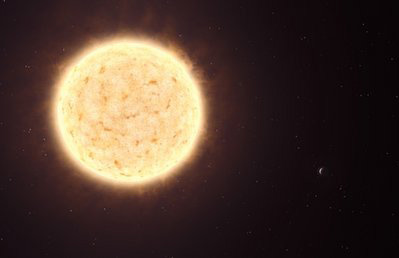
This artist's rendering provided by the European Southern Observatory shows a planet, appearing as a crescent at the lower-right of its parent star, HIP 13044 (L). [Photo/Agencies] |
WASHINGTON?- Scientists have discovered the first planet from another galaxy, sort of.
While some 500 planets have been identified in other parts of our galaxy?- the Milky Way?- none has been reported in other galaxies.
Now one has been discovered orbiting a star called HIP 13044, located about 2,000 light year away. While this star is now in the Milky Way, researchers reported in Thursday's online edition of the journal Science that it originated in a separate galaxy that was later cannibalized by ours.
| ||||


"This discovery is very exciting," Rainer Klement of Germany's Max Planck Institute for Astronomy, said in a statement.
"For the first time, astronomers have detected a planetary system in a stellar stream of extragalactic origin. Because of the great distances involved, there are no confirmed detections of planets in other galaxies. But this cosmic merger has brought an extragalactic planet within our reach."
The new planet is orbiting a star from what is known as the Helmi stream?- a group of stars that originally belonged to a dwarf galaxy that was devoured by the Milky Way about six to nine billion years ago.
The researchers say the new planet is also one of the few planets known to have survived the period when its host star expanded massively after exhausting the hydrogen fuel supply in its core. The star has now contracted again, they report.
Johny Setiawan, also from the Max Planck Institute, added that "this discovery is particularly intriguing when we consider the distant future of our own planetary system, as the Sun is also expected to become a red giant in about five billion years."
The study also raises questions about the formation of giant planets, the researchers said, since the host star appears to contain very few elements heavier than hydrogen and helium.
"It is a puzzle for the widely accepted model of planet formation to explain how such a star, which contains hardly any heavy elements at all, could have formed a planet. Planets around stars like this must probably form in a different way," said Setiawan.