Science and Health
US astronomers discover buckyballs in space
(Xinhua)
Updated: 2010-10-28 11:11
 |
Large Medium Small |
LOS ANGELES - Using NASA's Spitzer Space Telescope, astronomers have discovered bucket loads of buckyballs in space, the Jet Propulsion Loboratory (JPL) said on Wednesday.
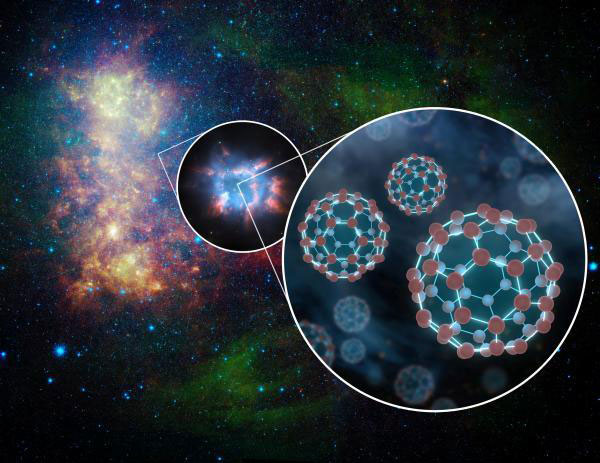
| An infrared photo of the Small Magellanic Cloud taken by Spitzer is shown here in this artist's illustration, with two callouts. The middle callout shows a magnified view of an example of a planetary nebula, and the right callout shows an even further magnified depiction of buckyballs, which consist of 60 carbon atoms arranged like soccer balls.[Photo/NASA] |
These cloudy objects, made up of material shed from the dying stars, are similar to the one where Spitzer found the first evidence for their existence, the JPL said.
| ||||


Buckyballs, also known as fullerenes, are soccer-ball-shaped molecules consisting of 60 linked carbon atoms. They are named for their resemblance to the architect Buckminster Fuller's geodesic domes.
The miniature spheres were first discovered in a lab on Earth 25 years ago, but it wasn't until this past July that Spitzer was able to provide the first confirmed proof of their existence in space. At that time, scientists weren't sure if they had been lucky to find a rare supply, or if perhaps the cosmic balls were all around.
"It turns out that buckyballs are much more common and abundant in the universe than initially thought," said astronomer Letizia Stanghellini of the National Optical Astronomy Observatory in Tucson, Arizona.
"Spitzer had recently found them in one specific location, but now we see them in other environments. This has implications for the chemistry of life. It's possible that buckyballs from outer space provided seeds for life on Earth."
The discovery shows that all the planetary nebulae in which buckyballs have been detected are rich in hydrogen. This goes against what researchers thought for decades - they had assumed that, as is the case with making buckyballs in the lab, hydrogen could not be present, the JPL said.
The hydrogen would contaminate the carbon, causing it to form chains and other structures rather than the spheres, which contain no hydrogen at all, said the JPL.
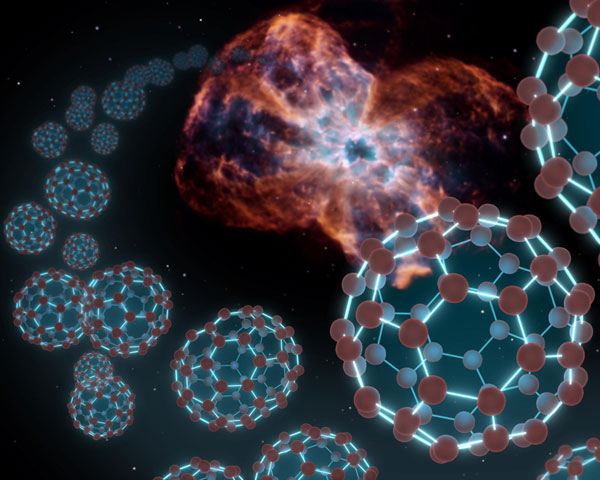
| NASA's Spitzer Space Telescope has at last found buckyballs in space, as illustrated by this artist's conception. [Photo/NASA] |