Science and Health
Living under flight path may be bad for the heart
(Agencies)
Updated: 2010-10-11 09:49
 |
Large Medium Small |
NEW YORK - Living with airplanes thundering over your head could put your heart at risk, according to a Swiss study.
After studying 4.6 million adults across Switzerland, researchers found that dying from a heart attack was more common among people with increased exposure to aircraft noise.
|
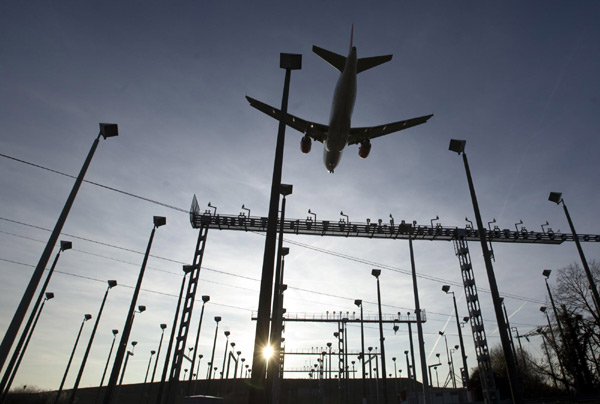 An aircraft makes its final approach before landing at Cointrin airport in Geneva in this Dec 8, 2008 file photo. Living with airplanes thundering over your head could put your heart at risk, according to a Swiss study. After studying 4.6 million adults across Switzerland, researchers found that dying from a heart attack was more common among people with increased exposure to aircraft noise. [Photo/Agencies] |
"The effect was especially evident for people who were exposed to really high levels of noise, and was dependent on how long those people had lived in the noisy place," researcher Matthias Egger of the University of Bern, told Reuters Health.


But this study could help determine whether the sound is really exerting the effect, or if it is something else tagging along with the noise, such as air pollution.
"It's been a problem that when you look at road traffic noise there are both high levels of noise and high levels of air pollution," said Egger. "By looking at airports we were in a position to disentangle these effects."
Egger and his colleagues identified 15,532 heart attack deaths among 4.6 million Swiss residents between late 2000 and the end of 2005 using detailed information from an ongoing mortality study called the Swiss National Cohort.
Government records and environmental data helped the team determine the distance of individuals' residences from airports and major roads, as well as relative levels of particulate matter in the vicinity.
This allowed the researchers to pinpoint both aircraft noise and air pollution exposures for each individual over a period of 15 years or longer.
After accounting for air pollution and other factors including education and income levels, the group found that both the level and duration of aircraft noise drove up the risk of a lethal heart attack.
People exposed to a daily average of at least 60 decibels of noise had a 30 percent greater risk of dying from a heart attack compared with those exposed to less than 45 decibels, the researchers report in the journal Epidemiology.
Among those exposed to the higher decibel levels for 15 or more years, the risk was actually 50 percent higher.
Measuring exposure is complicated by the fact that aircraft noise is intermittent and can temporarily soar above 100 decibels if you're close to one taking off or landing, explained Egger, but the average of 60 decibels is about what you would expect in a crowded, noisy bar.
Living within 100 meters of a major road also increased the risk of heart attack but the researchers found no impact of particulate-matter air pollution on the heart.
Egger said road and air traffic produce different noise patterns that might not be easily comparable as road traffic noise was more constant and arguably easier to get used to.
"Noise probably does have effects on health and it is important that we gain a better understanding of these," he said, adding that further studies were needed.
The researchers suggested that further measures could be added to protect people from noise such as sound barriers controlling the speed and volume of traffic and better home insulation.