Global General
Balance sought for climate change
By Li Xing (China Daily)
Updated: 2010-10-06 09:00
 |
Large Medium Small |
Tianjin - "Balance" is a catchphrase in the ongoing United Nations climate meeting in Tianjin.
In her opening address on Monday, Christiana Figueres, Executive Secretary of United Nations Framework Convention on Climate Change (UNFCCC), called for focusing on a consensus to ensure that the coming climate change conference in Cancun, Mexico, "deliver a balanced package of decisions".
For developing countries, balance can be achieved only when progress is made in the all of the major areas, which include mitigation actions, security of adequate financial resources, promise of technology transfer and establishment of a shared vision, according to Martin Khor, executive director of South Center, a Geneva-based non-government international organization of 51 developing countries, including China.
Khor and his colleagues have conducted a series of studies on climate change issues and for years followed the negotiations under the UNFCCC to further enhance global actions in tackling climate change.
Severe floods in Pakistan and China as well as serious forest fires in Russia this year highlighted the severity of climate change and increased the urgency for the world to take concerted actions, Khor said at a press conference on the sideline of the UN climate meeting in Tianjin.
The rise in the ocean temperature increased cloud formations and, as a result, caused monsoon rains in Pakistan, he said, quoting research from the World Meteorological Organization.
Despite the talks of "balance", Khor said he and his associates have found two main "imbalances" in the ongoing climate talks.
After more than four years' negotiations, draft texts for new amendments to the Kyoto Protocol have stipulated that developed countries under the Kyoto Protocol should limit and reduce their combined CO2 emissions by at least 25 to 40 percent from 1990 level by 2020.
However, he said some developed countries no longer wanted to go into the second phase of the Kyoto Protocol because the United States is not a member. They suggested voluntary pledges from each developed country.
"This is not acceptable, because it means dismantling the legally-binding system and collapse of top-down figure based on science," he said.


The other is imbalance between the priorities and pledges of the developed countries.
He noted that developed countries demand that developing countries' programs in tackling climate change be "measurable, reportable and verifiable" if those are funded by developed countries or supported with technologies they provide.
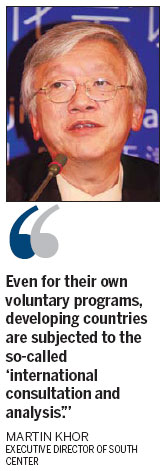
"Even for their own voluntary programs, developing countries are subjected to the so-called 'international consultation and analysis'," he said.
In this way, developing countries are under "heavy obligations", and not only must they put forward actions but their actions are scrutinized, Khor said.
While making their demands on developing countries, "some of the developed countries downgraded their own mitigation commitments from the (legally-binding) Kyoto Protocol to voluntary actions," he said.
In short, "they want the developing countries to do much more, while they do much less," he said.
"This is not fair. This is not balanced," he said.