Science and Health
Gladiator graveyard discovered in northern England
(Agencies)
Updated: 2010-06-08 13:26
 |
Large Medium Small |
LONDON?- Dozens of headless skeletons excavated from a northern English building site appear to be the remains of Roman gladiators, one of whom had bites from a lion, tiger, bear or other large animal, archaeologists said Monday.
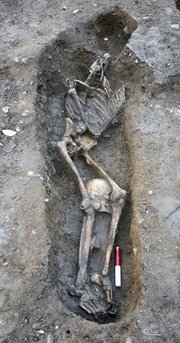 In this image provided by Channel 4 on June 6, 2010, a skeleton unearthed at a building site in York, England, is shown. Archaeologists said Monday that 80 headless skeletons excavated from the building site appear to be the remains of Roman gladiators. [Agencies]? |
Most of the skeletons were male and appeared stronger and taller than the average Roman, with signs of arm-muscle stress that suggest weapons training that began in the men's teenage years.
The team investigating the remains said that one of the best clues was carnivore tooth marks found on the hip and shoulder of one of the skeletons.
"The presence of bite marks is one of the strongest pieces of evidence suggesting an arena connection. It would seem highly unlikely that this individual was attacked by a tiger as he was walking home," said Michael Wysocki, a lecturer in forensic anthropology and archaeology who studied the skeletons. The bites were believed to have caused the person's death, he said.
York — about 200 miles (322 kilometers) north of London — was one of the largest cities in Roman Britain, and experts believe bands of gladiators touring the Roman Empire occasionally traveled here to put on fighting shows.
Wysocki said gladiators were often beheaded as an act of mercy after suffering horrific injuries during their fights. All of the skeletons were buried with pottery, animals or other offerings, suggesting they were respected people, not criminals.
But some experts said more evidence was needed to prove that the York burial ground was exclusively for gladiators.
"It's clearly a very intriguing cemetery, but I'm skeptical. Identifying gladiators is always tricky," said Jim Crow, the head of archaeology at the University of Edinburgh. "There could be a host of circumstances for a group of men who've lost their heads — they might be soldiers beheaded for some particular reason."
Jenny Hall, a senior curator of Roman archaeology at the Museum of London, said it was unlikely 80 fighters died while performing in York because the gladiator shows were expensive to put up and many were choreographed.
"We know that (gladiators) toured the empire, but very little is known about them in Britain," Hall said. "They would be performing for the local governor or a rich person, but it was probably on rare occasions."
The York Archaeological Trust said that the burial ground was not the first of its kind to be uncovered but it was among the best preserved.
The only other comparable gladiator cemetery is in Ephesus, Turkey, said Wysocki, who teaches at the University of Central Lancashire. The human remains found there were fragmented and not as complete as those unearthed in York, he said.
Archaeologists stumbled upon the York skeletons in 2003, when they were assessing an area due for housing development. The site was part of a large cemetery on the outskirts of the Roman town.
An excavation project followed, eventually uncovering 80 Roman skeletons — including 23 that were found in a local resident's back garden. The remains were believed to date from late 1st century to the 4th century A.D.
The findings were announced by Britain's Channel 4, which was producing a documentary about the discovery.