Global Biz
Europe debt crisis stirs recession fear
(Agencies)
Updated: 2010-05-22 11:26
 |
Large Medium Small |
BERLIN - A dark cloud has settled over the world's financial markets, as growing numbers of people are concluding the debt crisis in Europe could hammer global growth -- and even bring back recession barely a year after a patchy recovery took hold.
Government officials, whose job it is to boost confidence, downplay that risk, but many economists are warning that the much-feared "double-dip" recession could be starting in Europe.
|
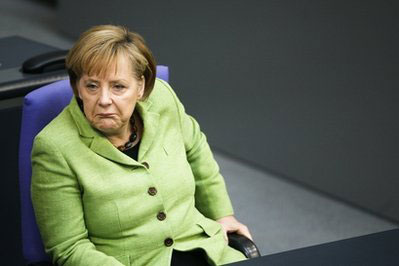 German Chancellor Angela Merkel reacts during the final parliament debate of an euro 750 billion (US$1 trillion) eurozone rescue package in Berlin, May 21, 2010. [Agencies] |
It would be the next ugly chapter in the global financial and economic turmoil that began three years ago. And now as then, what is striking is the inter-connectedness of everything -- how near-default in Greece and weeks of dithering in Germany have affected commodities like oil and gold and, with demand and confidence waning, have bludgeoned stock markets around the world in a way that rattles ordinary people saving for retirement from Korea to California.
In 2007, the bad debt connected to repackaged subprime mortgages started undermining banks and hedge funds, and by early 2008 confidence in the system was slipping fast.
This time it is the exposure of banks everywhere to sovereign debt, the IOUs of governments, whose value has been falling for months.
The sheer size of the European economy is a factor, said Mauro F. Guillen, director of the Lauder Institute at The Wharton School in Pennsylvania. "If European demand goes down, global growth will slow down," he said.
"A European economy that lags is not necessarily enough to put the world economy back into recession. But a European economy that cannot stabilize its currency and capital markets certainly will push the global economy back into the red." Nicholas Colas, ConvergEx Group chief market strategist, told The Associated Press. "A double dip is a possibility."
It is a daunting prospect, because having already deployed their best countermeasures -- stimulus spending and central bank interest rate cuts -- governments everywhere may be out of ammunition.
Stephen Lewis, a London-based economist with Monument Securities, spoke for many of the pessimists Friday after a week of market turmoil in Europe when he saw "no guarantee that the upswing in the global economy from 2009's low point will be sustained."
At the heart of the crisis are fears that indebted eurozone governments will not be able to pay what they owe. Those fears have sent the prices of government bonds -- many of them held by big banks in Germany and France -- plummeting. Europe also faces low growth prospects because governments must cut back on spending to pay down heavy debt loads.
If banks in Europe and beyond suffer losses on marked-down government bonds, this would then make them afraid to lend the money that businesses need to operate and expand, choking off growth -- a replay, in a sense, of the freezing of credit markets after the Sept. 2008 collapse of the US investment bank Lehman Brothers which led to a worldwide recession. The global economy shrank by 0.6 percent in 2009, its first dip since World War II.
"If sovereign debt concerns are accompanied by worries over bank liquidity any more significant than those currently influencing the credit market, another dip in world economic activity would seem a sure thing," Lewis said.
As fear spreads, stocks and the price of oil, both signs of expectations for future economic growth, have been drawn into the downdraft. And gold, traditionally a safe haven, has hit ominous all-time highs.
Most of the world's leading stock markets are below where they started the year as investors revise down their growth expectations for the global economy.
Reflecting the optimism that held sway until recently, the IMF in April slightly raised its 2010 global growth forecast to 4.2 percent, although eurozone growth was forecast at only 1 percent. Now even that looks optimistic.
Daniel Tarullo, a governor with the US Federal reserve, told a Congressional House subcommittee Thursday that Europe's crisis was a "potentially serious setback."
Tarullo said that the worst case financial turmoil -- possible but still unlikely -- "could lead to a replay of the freezing up of financial markets that we witnessed in 2008."
The latest crisis erupted in October, when the new government in Greece admitted its predecessors had lied about the size of their budget deficit. Instead of a manageable 3.7 percent of gross domestic product, it was a destabilizing 12.7 percent, since revised up to 13.6 percent.