Global General
BRIC wants changes soon to global financial system
By Ma Liyao and Hu Haiyan (China Daily)
Updated: 2010-04-17 08:43
 |
Large Medium Small |
|
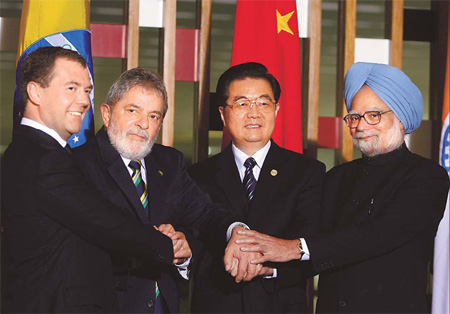 Russia's President Dmitry Medvedev (from left), Brazil's President Luiz Inacio Lula da Silva, China's President Hu Jintao and India's Prime Minister Manmohan Singh join hands at the BRIC summit at Itamaraty Palace in Brasilia on Thursday. [Agencies]
|
Growing powers call for fairer economic decision-making
BEIJING - The world's largest developing countries, including China, have called for changes to come sooner to the international financial system, which is dominated by a handful of developed nations.


However, observers said developing countries need more "detailed and feasible" plans if they want more influence on the world economy. They also need to be "more united", analysts suggested.
The call for a greater voice came during the second summit of the increasingly influential emerging powers. It was held in the Brazilian capital of Brasilia ahead of the G20 summit in Canada and the International Monetary Fund meetings in Washington.
The IMF and the World Bank need to urgently address their deficits of legitimacy, said the leaders in a communiqu, asking that "voting power reform of the World Bank be fulfilled in the upcoming spring meetings."
"A substantial shift in voting power in favor of emerging market economies and developing countries is needed to reform these institutions' governance structures, and to adjust their participation in decision making relative to their weight in the world economy," stated the communiqu.
World Bank President Robert B. Zoellick expressed a similar view the previous day by saying developed nations should cede more authority over the global economy.
The communiqu also called for a resistance against trade protectionism in all forms.
Meanwhile, the group spoke of "the importance of maintaining relative stability of major reserve currencies and the sustainability of fiscal policies in order to achieve strong, long-term balanced economic growth."
The summit's host, Brazilian President Luiz Inacio Lula da Silva, said "Brazil, Russia, India and China have a fundamental role in the construction of a fairer international order that is more representative and safe."
His Chinese counterpart, President Hu Jintao, pointed out that BRIC faces both challenges and opportunities and the four countries should enhance practical cooperation. Hu expressed the intention of hosting the third summit at the meeting.
Indian Prime Minister Manmohan Singh said "we support a multi-polar, equitable, democratic and just world order with the (United Nations) playing a central role in tackling global challenges," while calling the summit "very successful" and saying BRIC was "key to contributing to world economic growth and prosperity".
Russian President Dmitry Medvedev said the BRIC format is "becoming full-fledged and allows us to not only coordinate our efforts but to also make concrete decisions."
Analysts, however, were not that optimistic.
Pang Zhongying, a senior expert on world politics at Beijing-based Renmin University of China, said: "in order to be more influential, the developing countries should put forward more detailed and feasible plans."
BRIC countries have only 9.6 percent of the IMF's total votes, while the US has 16.7 percent. The Group of Eight, or the world's major developed countries and Russia, have 47.8 percent of the votes.
Last year the BRIC nations produced 15 percent of the global gross domestic product, with 40 percent of the global population.
Sun Hongbo, an expert on Latin American studies at the Chinese Academy of Social Sciences, emphasized the need to enhance bilateral cooperation between the countries.
"The developing countries should develop solid bilateral relations in the areas of finance, energy and investment," Sun said, adding that "financial cooperation and innovation should be promoted."
Zhang Haizhou contributed to the story.
China Daily