Global General
Musician creates quietly on his Baghdad rooftop
(China Daily)
Updated: 2010-03-31 08:34
 |
Large Medium Small |
BAGHDAD - In a tiny workshop on the roof of his home in a Baghdad slum, Farhan Hassan works in secret, lovingly curving wood and tightening strings to make his ouds, a traditional Arabic instrument.
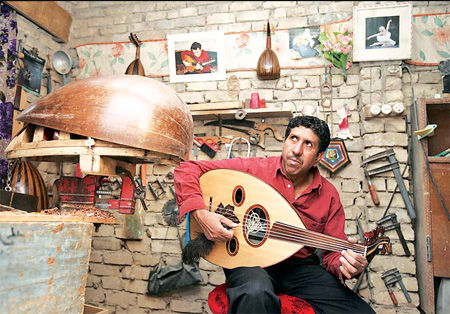 Farhan Hassan plays an oud at his workshop in Baghdad. [Agencies] |
Only close family and friends know what he is doing, because the militiamen in his neighborhood frown on such frivolities.
The oud's angst-filled tunes define Iraq's music, the same way the Tigris and Euphrates rivers define its landscape. But nowadays few in the country play or make the oud, a pear-shaped, deep-voiced cousin of the lute. Hundreds of artists fled Iraq during the violence in recent years - and continued instability and the power of religious hard-liners give them little desire to return.
So Hassan's ouds have come to symbolize a lost Iraq, or maybe the country it could become one day. What they don't speak of is today's Iraq.
"My country has no flowers, love or beauty," said Hassan, "I want to leave Iraq and go some place where I can have a normal life."
A gentle, soft-spoken man with unkempt hair and several front teeth missing, Hassan ships his ouds to buyers abroad - Iraqi musicians who fled Iraq over the years to escape the oppression of Saddam Hussein or the violence that followed his ouster in 2003. Among these are childhood friend Rahim al-Haj, a Grammy-nominated oud player and composer now living in the United States.
Al-Haj urges Hassan to mail as many ouds as possible to sell on his behalf. Al-Haj tours the US, playing his three Hassan ouds in concerts to benefit Iraqi children.
Al-Haj himself was separated from his first oud when a customs officer on the Iraq-Jordan border crossing insisted that he could not take it outside the country without a permit. He had a choice to make back then on a cloudy January day in 1991.
"I chose my freedom at the end, but I was sick for a long time afterward because of the loss of my oud," he said.
He tried to go home to Iraq in 2004, but instead went back to the US, horrified.
"I felt that the pain was far too great for me to handle," al-Haj said from his Albuquerque, N.M. home. "I discovered that my father died in 1997 while I was still in Syria. My mother died a month after I left."
Now Hassan is also hoping to leave Iraq. Like many of the estimated 2.5 million Shi'ites who live in Sadr City, he has had to cope with some of the city's worst living conditions. Militiamen have closed music stores, prohibited the mixing of the sexes, banned wedding parties, imposed the Islamic hijab on women and murdered gay men - all while making a living as hired guns.
During the dark days of militia rule up until two years ago, Hassan took his ouds and anything else in his workshop that would give away his profession to a brother's home in a safer Baghdad neighborhood. The militiamen came to the house twice in 2005, he recalled _ "in the middle of the night and wearing masks like highway robbers" - but left empty-handed.
"I could have gone out on the streets carrying an RPG or a machine-gun and people would either take no notice or commend me on my courage," he mused. "But I would have probably been killed if I had gone out with an oud in my hand," he said with a laugh tinged with bitterness.
Even now, the sign on a leaf-shaped piece of wood - "Farhan Hassan oud workshop" - is covered with cloth of a fading floral design. On the wall is a fading picture of a ballerina Hassan ripped off a German magazine he found when a teenager, along with an image of a young Charlie Chaplin and of Michelangelo's Pieta, a sculpture of a grief-stricken Virgin Mary with a dead Jesus on her lap. There is also a copy of a famous Iraqi painting of female gypsy dancers, and magazine pictures of two of Iraq's most renowned oud musicians - the late brothers Mounir and Gameel Bashir.
Hassan was born to a poor family that migrated to Baghdad from Iraq's impoverished south in the 1950s. Two of his brothers disappeared in the early 1980s. For years, the family suspected they had been executed for their communist party membership, but confirmation of their death only came from records uncovered after Saddam Hussein's 2003 ouster.
"Fayadh gave me my first oud," said Hassan, his eyes welling up as he spoke of the older of his two siblings. "He encouraged me to play music."
The overthrow of Saddam delivered Iraq's majority Shiites from years of oppression, but Hassan says the empowerment of his community did nothing to alleviate the pain over his lost siblings.
"Fayadh was like a father to me," he recalled, seated on the floor of a living room whose bare walls are adorned by an image of Imam Hussein, a seventh-century saint whose martyrdom in battle cemented the Shiite-Sunni divide.
With Iraq's best-known oud players gone abroad, there is little market for ouds.
"I have not sold a single oud in three months, so I work part-time as an ele with them."
In the meantime, Hassan is begging for help to leave Iraq.
"Please tell Rahim that I want to leave," he said. "Ask him to find out for me if I can study abroad."
Associated Press