Science and Health
NASA: Good night moon, hello new rocket technology
(China Daily)
Updated: 2010-02-02 09:35
 |
Large Medium Small |
WASHINGTON: US President Barack Obama is redirecting America's space program, killing NASA's $100 billion plans to return astronauts to the moon and using much of that money for new rocket technology research.
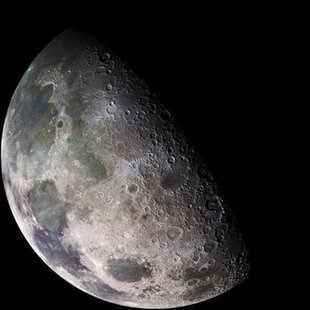 This 2009 NASA handout image shows a color mosaic of the moon, assembled from 18 images taken by Galileo's imaging system through a green filter. [Agencies]? |
"Simply put, we're putting the science back into the rocket science at NASA," White House science adviser John Holdren said at a budget briefing Monday.
The $4 billion that NASA spends yearly on human space exploration will now be used for what NASA and White House officials called dramatic changes in rocketry, including in-orbit fueling. They said eventually those new technologies would be used to send astronauts to a nearby asteroid, a brief foray back to the moon, or the Martian moons.
The White House plan was short on details, such as where astronauts would fly next, on what type of rocketship, or when. However, officials were quick to point out the failures of the Bush administration's moon program, called Constellation. It included the construction of two types of rockets, Ares I and Ares V, and an Orion crew capsule. All were canceled. Shutting down the program will cost about $2.5 billion, NASA said.
| ||||


Sen. Bill Nelson, D-Fla., and chairman of the Senate space subcommittee, said he will hold a hearing later this month to see if Congress could rescue some parts of the Ares rocket programs.
"This is a pretty substantial change," said MIT astronautics professor Ed Crawley, who was on a special panel that looked at the future of spaceflight for the White House. "It is more change than I thought they'd take on."
Crawley said the Bush moon plan was well thought out, but based on existing technologies and underfunded.
"We didn't lose the moon today; we very subtly lost the moon a long time ago when the amount of money disappeared a few years ago," Crawley said.
Besides redirecting money to new technologies, NASA is getting an extra $6 billion over five years to encourage companies to build private spaceships that NASA could rent. Many of those companies are run by Internet pioneers, including Blue Origin, headed by Amazon founder Jeff Bezos. Another firm, SpaceX, run by PayPal founder Elon Musk, is already building private rockets.
In a teleconference Monday, Musk said that within three years of getting a contract with NASA, he could deliver astronauts to the International Space Station for about $20 million a head — cheaper than the $50 million Russia is charging the United States.
NASA now has seven companies getting money to work on planning for some types of commercial spaceships.
Former NASA associate administrator Scott Pace, now a professor of space policy at George Washington University, said relying so much on commercial companies is taking a big chance because they might not deliver on time or on budget.
"The risks are higher, the goals are more vague," Pace said of the new space policy. "It's more money but probably not enough."
NASA will also spend an additional $2.5 billion over five years for more research on how global warming is affecting Earth, including replacing a carbon dioxide monitoring satellite that crashed last year. NASA will also extend the life by several years of the International Space Station, which had been slated for retirement in 2016. NASA's yearly budget is $19 billion.
NASA said if the private companies work well on their unproven spaceships, astronauts could fly in them to the space station as soon as 2016. After the next five space shuttle flights, NASA will have to hitch rides to the space station on Russian rockets.
"The truth is we were not on a sustainable path to get back to the moon," NASA administrator Charles Bolden said in a telephone conference call. "We were neglecting investments in key technologies."
Congressional officials howled over lost programs and jobs, but it is hard for Congress to save such a large program that is being cut with redistributed money. Sen. Richard Shelby, R-Ala., called the cancellation of the moon mission the "death march for the future of US human space flight."