Global General
Trained dogs sniff out hidden bombs in Afghanistan
(Agencies)
Updated: 2010-01-29 15:23
 |
Large Medium Small |
|
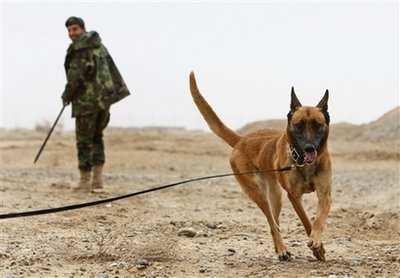 Tosca, a Belgium Malanois explosive detector dog works to sniff out explosives during a training exercise with the Afghan National Army (ANA) in Kandahar, southern Afghanistan on Saturday, Jan 23, 2010. Canadian forces are working with the ANA to assist them in conducting searches with dog teams.[Agencies]  |
TORA, Afghanistan: A French officer unleashed Arry, and the tall and muscular dog went to work.
Wagging his tail in the early morning chill, he ran under four Afghan tractor-trailer trucks, sniffing at the exhaust pipes and motor. He then jumped into the cabins, slipping behind the driver's seats and sticking his nose into the glove compartments. A driver's partially eaten snack was ignored.
In less than 10 minutes, the trucks were cleared for entry to Tora Forward Operating Base in eastern Afghanistan, and Arry started barking for more.
The US and its allies are turning increasingly to sniffer dogs to counter roadside bombs and suicide attacks, a major threat in the Afghan war. They can locate low-tech devices without metal parts or traditional explosives, which are nearly impossible to find with mine-detection equipment. The use of so-called "undetectable" bombs appears to be on the rise in Taliban strongholds in Afghanistan's south and east.
"Sniffer dogs have something better than any machine: instinct," said Chief Cpl. Remy, Arry's handler at the French Foreign Legion base.
Remy, who gave only his first name under French military regulations, said he was more than 90 percent confident that a road searched by his dog could be declared free of bombs.


IEDs, short for improvised explosive devices, were responsible for 129?US military deaths in Afghanistan in 2009, more than 40 percent of the total, according to an Associated Press tally based on daily NATO reports. The devices also take a toll on Afghan civilians, killing 117 in the last four months of 2009.
Arry, a 4-year-old Belgian Malinois, looks much like a German shepherd, only lankier and faster. Malinois were once used to protect cattle herds but now mostly serve as protection dogs or pets.
The dogs with the best sense of smell are usually hunting breeds, such as the Labrador retrievers used by the?US ?Marines in Afghanistan's Helmand province, where they are trained to detect conventional explosives.
But the French army exclusively employs Malinois in Afghanistan, because they are more multipurpose. They can sniff out drugs, guard a camp or help with crowd control. The 3,500 French troops in Afghanistan have a dozen dogs doing these tasks, all of them males.
"Suspects at a checkpoint have no way of telling if they face an attack dog or a sniffer," said Sgt. Sylvain, who handles Agos, a 70-pound (32-kilogram) Malinois attack dog that can easily topple a man, bite a target six-feet (two-meters) high or break through a car window when wearing a metal-reinforced muzzle.
Homemade bombs are often built with scrap parts and readily available fertilizers, such as ammonium nitrate, or cheap aluminum powder. They are often set off remotely by what some NATO troops call "Pakistani wires" — a tiny electric cable that can run dozens of yards (meters) to a detonator.
It took four months of intense training to teach Arry how to detect such bombs, along with more conventional explosives that use cordite, plastic or dynamite substances.
"We basically added nitrates powder to the range of chemicals the dog reacts to," Remy said.
Arry can now spot more than 20 different molecules, which allows him to detect just about any IED. If the soil has been recently upturned, Arry can smell an explosive hidden up to three feet (one meter) below the surface. And if there's even the slightest breeze blowing in the right direction, he can start sniffing a bomb 100 yards (100 meters) away, Remy says.
"There are only so many basic molecules that can be used to make a bomb, and a good dog can be trained to find them all," Remy said. "Dogs are the very best thing against explosives."
There are limitations to what dogs can do. It's difficult to bring them to the front line or to feed and maintain them in more remote outposts. There are also only so many trained handlers and dogs available, and expanding their numbers would take years.
Dogs such as Arry serve in the French army until they are 8 or 9 years old. Most then retire at their handler's home, except for the more aggressive ones, which are put to death.
Sgt. Major Edouard, the head of a French special intervention bomb squad in Afghanistan, was a skeptic at first but found the dogs to have a 100 percent success rate during trials, when he hid undetectable bombs for them to find. "They were very effective," he said.