Asia-Pacific
NATO: US spy work lacking in Afghanistan
(Agencies)
Updated: 2010-01-05 19:51
 |
Large Medium Small |
|
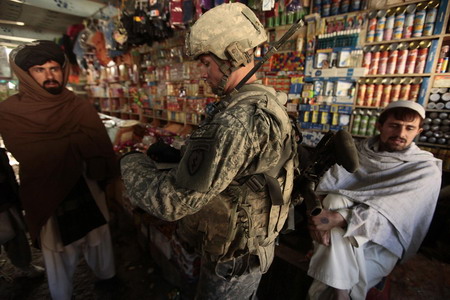 A US Army soldier from Task Force Denali 1-40 CAV combat team collects information on shops owners at the bazaar during a patrol in town of Saway-kowt in Khowst province, Afghanistan, December 21, 2009. [Photo/Agencies] |
KABUL: Eight years into the war in Afghanistan, the US intelligence community is only "marginally relevant" to the overall mission, focusing too much on the enemy and not enough on civilian life, according to NATO's top intelligence official.
The stinging assessment -- released less than a week after a suicide bomber killed seven CIA employees and a Jordanian intelligence officer in eastern Afghanistan -- said field agents are not providing intelligence analysts with the information needed to answer questions asked by President Barack Obama and the top commander in Afghanistan, Gen. Stanley McChrystal.


The officials "can do little but shrug in response to high-level decision makers seeking the knowledge, analysis and information they need to wage a successful counterinsurgency," Flynn wrote in the report, which was co-authored by his adviser, Capt. Matt Pottinger, and Paul Batchelor with the Defense Intelligence Agency.
"These analysts are starved for information from the field, so starved, in fact, that many say their jobs feel more like fortune telling than serious detective work," said the report. "It is little wonder then that many decision makers rely more on newspapers than military intelligence to obtain 'ground truth."'
Field intelligence officers should not limit their reports to diagraming insurgent networks, Flynn suggested. They also should provide information about meetings with villagers and tribal leaders, translated summaries of local radio broadcasts that influence local farmers and field observations of Afghan soldiers and aid workers.
Flynn suggested setting up one-stop information centers where unclassified information could be organized and made available to the military, donor nations and aid workers.
The report does not mention the CIA, which suffered a deadly blow to its operations on December 30 when a suicide bomber attacked inside Camp Chapman, a highly secured forward base in eastern Khost province. The agency could not immediately be reached Tuesday for comment on the report.
The report uses "intelligence community" to refer to the thousands of uniformed and civilian intelligence personnel serving with the Defense Department and joint interagency operations in the country.
In conventional warfare, troops depend on big picture intelligence to figure out their ground strategies, but in a counterinsurgency, troops, aid workers and others on the ground are usually the best informed about the enemy, the report said. Brigade and regional command intelligence summaries that rehash the previous days fighting are of little use compared with periodic reports that also address changes in the local economy, corruption and governance.
"I don't want to say we're clueless, but we are," according to an operations officer quoted in the report. "We're no more than fingernail deep in our understanding of the environment."
"The US intelligence community is only marginally relevant to the overall strategy," the report concluded.
When he took command in Afghanistan in June 2009, McChrystal made similar calls for collecting more "white" information about local goings-on along with "red" analysis about enemy activities. Lt. Gen. David Rodriguez, second-in-command to McChrystal, subsequently ordered regional commands to begin answering wide-ranging questions about the Afghan government and local populations. Little, however, has changed in the collection of mostly enemy-related intelligence, the report said.
The report quotes McChrystal as saying in a recent meeting: "Our senior leaders, the chairman of the Joint Chiefs of Staff, the Secretary of Defense, Congress, the president of the United States, are not getting the right information to make decisions with. We must get this right. The media is driving the issues."