Global General
192 nations at UN climate change conference in Copenhagen
(Agencies)
Updated: 2009-12-07 19:49
COPENHAGEN: The largest and most important UN climate change conference in history opened Monday, with diplomats from 192 nations warned that this could be the best, last chance for a deal to protect the world from calamitous global warming.
|
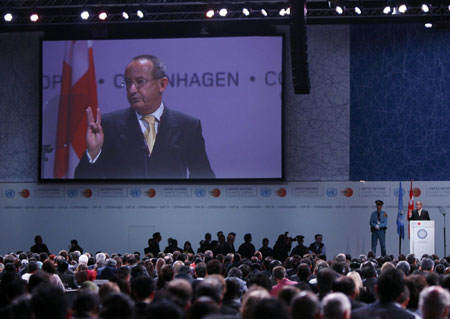 UN climate chief Yvo de Boer speaks during the opening of the United Nations Climate Change Conference 2009, also known as COP15, at the Bella center in Copenhagen December 7, 2009. [Agencies] |
The conference, the climax of two years of contentious negotiations, convened in an upbeat mood after a series of promises by rich and emerging economies to curb their greenhouse gases, but with major issues yet to be resolved.


Hedegaard — Denmark's former climate minister — said if governments miss their chance at the Copenhagen summit, a better opportunity may never come.
"This is our chance. If we miss it, it could take years before we got a new and better one. If ever," she said in prepared remarks.
Denmark's prime minister said 110 heads of state and government will attend the final days of the two-week conference. President Barack Obama's decision to attend the end of the conference, not the middle, was taken as a signal that an agreement was getting closer.
At stake is a deal that aims to wean the world away from fossil fuels and other pollutants to greener sources of energy, and to transfer hundreds of billions of dollars from rich to poor countries every year over decades to help them adapt to climate change.
Scientists say without such an agreement, the Earth will face the consequences of ever-rising temperatures, leading to the extinction of plant and animal species, the flooding of coastal cities — about half of humanity lives with 100 miles (160 kilometers) of a coastline — more extreme weather events, drought and the spread of diseases.
Negotiations have dragged on for two years, only recently showing signs of breakthroughs with new commitments from The United States, China and India to control greenhouse gas emissions.
The first week of the conference will be focused on refining a complex text of a draft treaty. But major decisions will await the arrival next week of environment ministers and the heads of state in the final days of the conference, which is due to end Dec. 18.
Among those decisions is a proposed fund of $10 billion each year for the next three years for poor countries prepare climate change strategies. After that, hundreds of billions of dollars will be needed every year to set the world on a new energy path and adapt to new climates.
"The deal, that we invite leaders to sign up on, will be one that affects all aspects of society just as the changing climate does," said Danish Prime Minister Lars Loekke Rasmussen. "Negotiators cannot do this alone, nor can politicians. The ultimate responsibility rests with the citizens of the world, who will ultimately bear the fatal consequences, if we fail to act."
A study released by the UN Environment Program Sunday indicated that pledges by industrial countries and major emerging nations fall just short of the reductions of greenhouse gas emissions that scientists have said are needed.
Environmentalists have warned that emissions commitments were dangerously short of what UN scientists have said were needed to keep average temperatures from rising more than 2 degrees C (3.6 F).