WORLD> Asia-Pacific

|
WORLD> Asia-Pacific
|
|
A look at rival leaders in Japan election
(Agencies)
Updated: 2009-08-30 10:05
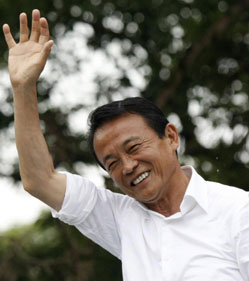
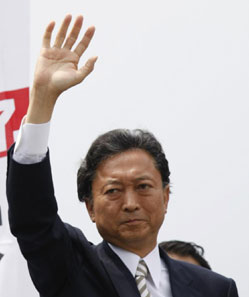
TARO ASO: The conservative prime minister was elected president of the ruling Liberal Democratic Party last September after his two predecessors each lasted only a year in office. He vowed to restore public confidence in the party, but his support ratings quickly fell as the worsening recession sapped voter support for the party.Aso, 68, is one of Japan's most colorful politicians. He is the country's first Roman Catholic prime minister, is an Olympic skeetshooter and is known for his penchant for Cuban cigars, comic books and gold necklaces. The grandson of former Prime Minister Shigeru Yoshida, who co-founded the ruling party and held the country's top office in 1946-1954, Aso is a political blue blood. His wife's father was the late Prime Minister Zenko Suzuki, and his sister married into the royal family. After graduating from Tokyo's Gakushuin University in 1963, he studied at Stanford University and the London School of Economics. He was president of his family's Aso Cement Co. from 1973-1979. Last year, he acknowledged his family mining business used more than 300 Allied prisoners of war as forced laborers in the final months of World War II. First elected to parliament in 1979, Aso has served several key party and Cabinet posts, most recently as foreign minister. YUKIO HATOYAMA: President of the Democratic Party of Japan, Hatoyama, 62, is the grandson of Ichiro Hatoyama, who was premier from 1954-1956 and was also a co-founder of the Liberal Democratic Party. His father, Iichiro, served as foreign minister and his younger brother Kunio has served several minister posts in the Aso government.
Hatoyama studied engineering at the prestigious University of Tokyo and earned his Ph.D. at Stanford University before starting a teaching career. In 1983, he became a private secretary to his father, and was elected to parliament three years later. He has since been re-elected seven times. Hatoyama left the ruling party in 1993 and joined the opposition to form an eight-party coalition government. He then co-founded the Democratic Party of Japan with several other ex-LDP barons. The Democrats capitalized on economic problems and ruling party scandals to win the 2007 elections to gain control of the upper house. Stiff and professor-like, Hatoyama is not seen as charismatic and has a tendency to be verbose and dismissive. He has been nicknamed "the alien" because he can come across as eccentric or aloof. Hatoyama promises to cut wasteful government spending, rein in the powerful bureaucracy and put more money in consumers' pockets by postponing tax hikes that the ruling party has said are in the works. Hatoyama also wants Japan to be closer to Asia and more independent from the US, Japan's biggest trading and military ally, though he stressed that their alliance would remain "the cornerstone" of Japanese diplomacy. |