WORLD> Global General

|
WORLD> Global General
|
|
Human laughter similar to that of apes, chimps
(China Daily)
Updated: 2009-06-05 08:43 NEW YORK: When scientists set out to trace the roots of human laughter, some chimps and gorillas were just tickled to help. Literally.
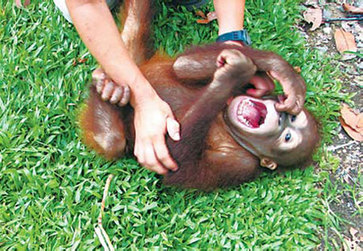
Experts praised the work. It gives strong evidence that ape and human laughter are related through evolution, said Frans de Waal of the Yerkes National Primate Research Center at Emory University in Atlanta. As far back as Charles Darwin, scientists have noted that apes make characteristic sounds during play or while being tickled, apparently to signal that they're interested in playing. It's been suggested before that human laughter grew out of primate roots. But ape laughter doesn't sound like the human version. It may be rapid panting, or slower noisy breathing or a short series of grunts. So what does that have to do with the human ha-ha? To investigate that, Marina Davila Ross of the University of Portsmouth in England and colleagues carried out a detailed analysis of the sounds evoked by tickling three human babies and 21 orangutans, gorillas, chimps and bonobos. After measuring 11 traits in the sound from each species, they mapped out how these sounds appeared to be related to each other. The result looked like a family tree. Significantly, that tree matched the way the species themselves are related, the scientists reported online yesterday in the journal Current Biology. They also concluded that while human laughter sounds much different from the ape versions, its distinctive features could well have arisen from shared ancestral traits. Jaak Panksepp of Washington State University, who studies laughter-like responses in animals but didn't participate in the new work, called the paper exciting. Panksepp's own work concludes that even rats produce a version of laughter in response to play and tickling, with chirps too high-pitched for people to hear. Robert Provine, a neuroscientist at the University of Maryland, Baltimore County, who wrote the 2000 book, Laughter: A Scientific Investigation, said the new paper reveals some important insights, like ape sounds that hadn't been appreciated before. AP |