WORLD> America

|
WORLD> America
|
|
Obama backs Gitmo plan, Cheney defends Bush policy
(Agencies)
Updated: 2009-05-22 11:55 "The president wrapped himself in the Constitution and then proceeded to violate it," said Michael Ratner, president of the Center for Constitutional Rights, a human rights group.
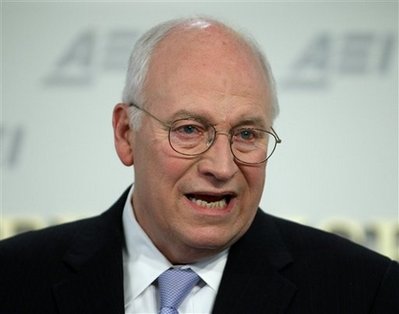
On the other side, Obama has invited conservative criticism for banning harsh "enhanced" methods of interrogating terrorist suspects, for releasing memos detailing the techniques and the Bush administration's legal justification for them, and for promising to close the Guantanamo Bay facility by next January. Shutting down the Caribbean island prison, which has left the US open to global condemnation since its inception and still holds 240 prisoners, is the most fraught — both logistically and politically. Obama wants to release some of the prisoners to their home countries, send some who can't be let go to other nations for detention, and try some either through military tribunals or in regular federal courts. He called a fifth category, an unspecified number who can neither be tried nor released, "the toughest issue we will face." Actually, each category poses significant problems. Abroad, US officials are having very minimal success persuading allies to take those deemed suitable for release, some 50 of the 240 by Obama's count. At home, politicians from both parties are balking at the idea of terror suspects — either those convicted in a judicial proceeding or those to be held indefinitely — being housed in their communities. This has handed Republicans a rare point-scoring opportunity. They were even helped this week when FBI Director Robert Mueller said it would be risky to relocate Guantanamo prisoners to US facilities. As a result, both the House and Senate now are on record against Obama's request for $81 million to close Guantanamo without a detailed accounting of where the detainees will go. The White House announced Thursday's speech last week shortly after news surfaced that Cheney was planning his. Aides scheduled it for the hour just before the former vice president's planned appearance at the American Enterprise Institute, a conservative think thank. The aim was to rebut Cheney's campaign with all the power of the presidency — not only Obama's singular rhetorical skills but also the ability of any White House to apply nearly unlimited resources to event-staging. But it also had the effect of elevating Cheney even more, to equal billing in television shows, Webcasts and newspapers. In deliberate tones that echoed off the museum rotunda's high walls and marble floors for over 45 minutes, Obama said he was doing away with the "poorly planned, haphazard approach" under the Bush administration that has seen a portion of the 525 detainees released from Guantanamo return to the battlefield. To do so, his administration was studying each Guantanamo case one-by-one — "quite simply, a mess," he said. But, the president added, "If we refuse to deal with these issues today, then I guarantee you that they will be an albatross around our efforts to combat terrorism in the future." Republicans were not impressed. "With all due respect to the president, what we need here is not a speech but a plan," said Senate Minority Leader Mitch McConnell of Kentucky. Obama acknowledged directly for the first time that some Guantanamo prisoners will end up in the US under his plan. He argued it would be done safely. "Nobody has ever escaped from one of our `supermax' prisons which hold hundreds of convicted terrorists," he said. Afterward, Senate Majority Leader Harry Reid, D-Nev. softened his opposition to bringing Guantanamo prisoners to the US, saying he is willing to work on a compromise. Obama chastised what he called "absolutist" critics on both sides who he said are more interested in scoring political points than finding solutions. Some on the left, he said, "would almost never put national security over transparency." Some on the right, meanwhile, are an "anything goes" crowd. "I've heard words that frankly are calculated to scare people rather than educate them," Obama said. "We will be ill-served by the fear-mongering that emerges whenever we discuss this issue," he declared. Yet the president himself repeatedly criticized Bush, who he said "failed to use our values as a compass" in devising an anti-terror strategy. "Too often, our government made decisions based upon fear rather than foresight and all too often trimmed facts and evidence to fit ideological predispositions," he said. Cheney, meanwhile, praised Obama for two "wise" decisions — his handling of the war in Afghanistan and his decision on the prisoner-abuse photos. But he forcefully defended the Bush administration's interrogation program and other policies enacted in the wake of the 2001 terrorist attacks. "Seven-and-a-half years without a repeat is not a record to be rebuked and scorned," Cheney said.
|