WORLD> Global General

|
WORLD> Global General
|
|
NASA telescope will hunt for Earth-like planets
(Agencies)
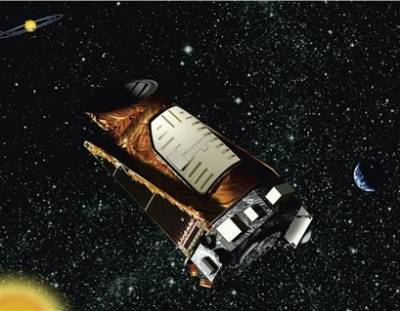
Updated: 2009-03-06 15:50 CAPE CANAVERAL, Fla. – NASA will soon be on the lookout for possible Earths in one faraway corner of the galaxy. A planet-hunting spacecraft, named Kepler after the German 17th-century astrophysicist, is scheduled to rocket away from Cape Canaveral late Friday night. Excellent launch weather is forecast.
The telescope will spend 3 1/2 years staring at roughly 100,000 stars, measuring their brightness and any winks in the light that might signify orbiting planets. "We certainly won't find E.T., but we might find E.T.'s home by looking at all of these stars," Bill Boruki, Kepler's principal scientist, said Thursday.
"It very possibly could tell us that Earths are very, very common, that we have lots of neighbors out there, or it could tell us that Earths are really, really, really rare," Weiler said at a press conference. "Perhaps we're the only Earth. I think that would be a very bad answer because I, for one, don't want to live in an empty universe where we're the best there is. That's a scary thought to many of us." Kepler will be scouting for Earth-size planets circling stars in the so-called habitable or Goldilocks zone. That's where planets are neither too close nor too far from their star, and where conditions could be ripe for liquid water on the surface. "Planets that are not too hot, not too cold, but just right," according to Boruki. Once launched, Kepler will trail the Earth in an orbit around the sun. It will peer continuously at a large patch of sky near the Cygnus and Lyra constellations, looking for any winks against the brightness of the stars that could indicate passing planets. The stars to be observed by Kepler are between 600 and 3,000 light years away. Project manager Jim Fanson of NASA's Jet Propulsion Laboratory in Pasadena, Calif., said the level of precision needed to measure those winks is incredibly high. "It's akin to measuring a flea as it creeps across the headlight of an automobile at night," Fanson said. Over the past decade and a half, more than 300 planets have been found to be orbiting stars outside our solar system. But these are largely gas giants like Jupiter. Kepler is designed to zero in on smaller, rocky, Earth-like planets. Scientists stress that Kepler — 15 feet high and 9 feet in diameter — will not be looking for life but rather potentially habitable planets. The mission costs $600 million, from start to finish. The launch comes on the heels of a failed flight of a NASA science satellite from California, the Orbiting Carbon Observatory, just over a week ago. It used a different rocket than the one for Kepler; nonetheless, engineers pored over every single detail to find any similarities and delayed Kepler's launch by one day. |
||||||