WORLD> Europe

|
WORLD> Europe
|
|
Engine trouble possible cause in Dutch plane crash
(Agencies)
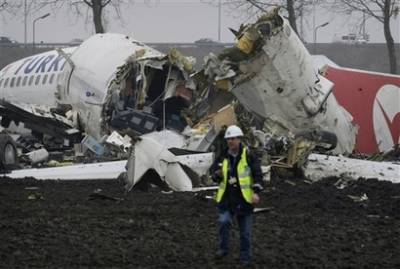
Updated: 2009-02-27 15:41 AMSTERDAM -- Engine trouble may have caused the Turkish Airlines crash that killed nine people in the Netherlands, the head of the agency investigating the accident said Thursday. Other officials identified the dead as five Turks and four Americans. Flight TK1951 from Istanbul crashed about one mile (1.5 kilometers) short of the runway at Amsterdam's Schiphol Airport on Wednesday morning, smashing into three pieces and spraying luggage and debris across a field. It was carrying 135 passengers and crew.
Spokeswoman Sandra Groenendal of the Dutch Safety Authority confirmed his remarks and added that engine failure on the was still only "one of the possible scenarios" for the crash. Van Vollenhoven said an analysis of the plane's flight data recorders in Paris could be completed as early as Friday, but his agency would probably not make a preliminary finding until next week. "We hope to have a firmer grip as soon as possible," he said, adding that the information retrieved from the recorders was of high quality.
Survivors say engine noise seemed to stop, the plane shuddered and then simply fell out of the sky tail-first. Witnesses on the ground said the plane dropped from about 300 feet (90 meters). Haarlemmermeer mayor Theo Weterings said five Turks and four Americans were killed in the crash. He said that the names of the victims would not be released until the bodies have been formally identified. Boeing Co. said late Thursday that two of its employees were killed and third injured in the crash. Boeing previously provided the names of its four employees who were aboard the plane, but its latest statement did not specify which were killed or injured. Haarlemmermeer also said Thursday that investigators now say 135 passengers and crew were on the flight, not 134 as previously believed, which was one reason it had taken so long to account for the dead. At the crash site Thursday, investigators took detailed photos of the wreckage, trying to piece together why the plane lost speed and crashed. One survivor, Henk Heijloo, said the last message he heard from the captain was for flight crew to take their seats. He said it took him time to realize the landing had gone wrong. "We were coming in at an odd angle, and I felt the pilot give the plane more gas," he said. He thought the pilot might have been trying to abort the landing, because the nose came up. Then he realized the landing was too rough to be normal and a moment later he felt an enormous crash. He walked away apparently uninjured, but his body began aching Thursday, he said. Turkish Airlines chief Temel Kotil said the captain, Hasan Tahsin Arisan, was an experienced former air force pilot. Turkish officials said the plane was built in 2002. Turkish Airlines issued a statement Thursday denying reports that the plane had had technical problems in the days before the accident. It confirmed the plane had undergone routine maintenance on Feb. 19, and that it had to delay a flight Feb. 23 to replace a faulty caution light. A retired pilot who listened to a radio exchange between air traffic controllers and the aircraft shortly before the crash said he didn't hear anything unusual. "Everything appeared normal," said Joe Mazzone, a former Delta Air Lines captain. "They were given clearance to descend to 7,000 feet." The recording was posted by the Web site LiveATC.net, which captures air traffic exchanges by monitoring scanners near airports. "Turkish 1951 descending from level 7-0," one of the pilots said as they neared the airport, referring to the plane's altitude of 7,000 feet. The controller cleared the plane to descend to an altitude of 4,000 feet, where it would intercept an electronic beam guiding the plane to the runway. The controller then read out the proper radio frequency for requesting clearance to land. "Turkish 1951 contact the tower 11827, bye bye," he said "Thank you, sir," the pilot said. There was no indication of trouble in his voice. Weather at the airport at the time was cloudy with a slight drizzle. |
||||||