WORLD> Global General

|
WORLD> Global General
|
|
NASA spacecraft to seek out Earth-like planets
(Agencies)
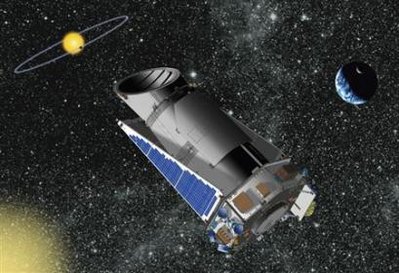
Updated: 2009-02-20 09:25 WASHINGTON -- A US spacecraft toting the biggest camera ever sent into space will be launched next month to scour our region of the Milky Way galaxy for warm, rocky planets like Earth that may host life, NASA said on Thursday. The Kepler spacecraft is scheduled to spend 3-1/2 years looking at more than 100,000 stars similar to our sun, seeking evidence of planets similar in size and composition to Earth.
Kepler is scheduled to blast off from Cape Canaveral Air Force Station in Florida aboard a Delta II rocket on March 5, the US space agency said. Colorado-based Ball Aerospace and Technologies, a subsidiary of Ball Corp, built it. People long have pondered whether life exists elsewhere in the universe or whether Earth alone hosts living beings. "Kepler will push back the boundaries of the unknown in our patch of the Milky Way galaxy. And its discoveries may fundamentally alter humanity's view of itself," Jon Morse, director of NASA's astrophysics division, told reporters.
This mission is intended to find rocky planets orbiting in the "habitable zone" around a star where they are not so close as to be scorched and not so far away as to be frozen. "What we're interested in finding are planets that are not too hot and not to cold, but just right," said William Borucki of NASA's Ames Research Center at Moffett Field in California. "We're looking for planets where the temperature is just about right for liquid water on the surface of the planet. And that's the area we think might be conducive to life," he said. Water is considered an essential ingredient for life. Borucki estimated the Kepler spacecraft may detect perhaps 50 such planets, but nothing is guaranteed. "If we find that many, it certainly will mean that life may well be common throughout our galaxy -- that there is an opportunity for life to have a place to evolve," he said. If none or only a few of these planets are found, it might suggest that habitable planets like Earth are very rare and Earth may be a lonely outpost for life, Borucki added. "They may be water worlds without plate tectonics that force the land mass up above the ocean. These could be worlds that in fact have life like our oceans, but perhaps not sending radio signals to us," said planet hunter Debra Fischer of San Francisco State University in California. Some star systems are oriented in a manner in which planets in orbit cross in front of the stars, as seen from the vantage point of Earth. The Kepler telescope, with the largest camera ever launched into space, is designed to detect the dimming of these faraway stars as planets pass in front of them. The spacecraft is named for Johannes Kepler, the German astronomer who lived from 1571 to 1630 and studied planetary motion. NASA said the mission will cost $591 million. |