WORLD> America

|
WORLD> America
|
|
Fed lowers economic forecast for 2009
(Agencies)
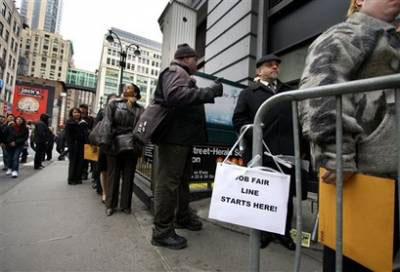
Updated: 2009-02-19 09:39 WASHINGTON – The US Federal Reserve on Wednesday sharply downgraded its projections for the country's economic performance this year, predicting the economy will actually shrink and unemployment will rise higher. Under the new projections, the unemployment rate will rise to between 8.5 and 8.8 percent this year. The old forecasts, issued in mid-November, predicted the jobless rate would rise to between 7.1 and 7.6 percent.
The Fed also believes the economy will contract this year between 0.5 and 1.3 percent. The old forecast said the economy could shrink by 0.2 percent or expand by 1.1 percent. The last time the economy registered a contraction for a full year was in 1991, by 0.2 percent. If the Fed's new predictions prove correct, it would mark the weakest showing since a 1.9 percent drop in 1982, when the country had suffered through a severe recession. The bleaker outlook represents the growing toll of the worst housing, credit and financial crises since the 1930s. All of those negative forces have plunged the nation into a recession, now in its second year. "Given the strength of the forces currently weighing on the economy," Fed officials "generally expected that the recovery would be unusually gradual and prolonged," according to documents on the Fed's updated economic outlook. Against that backdrop, unemployment -- now at 7.6 percent, the highest in more than 16 years -- will keep climbing and stay elevated for quite some time, the Fed predicted. Fed officials anticipated that unemployment would remain "substantially" higher than normal at the end of 2011 "even absent further economic shocks." The Fed forecast calls for the jobless rate to dip to between 8 and 8.3 percent next year, and to between 7.5 and 6.7 percent in 2011. All those projections are worse than the Fed's previous estimates and would put unemployment higher than the normal range around 5 percent. Employment is usually the last piece of the economy to heal once the country is out of recession and in recovery mode. Businesses are usually reluctant to ramp up hiring until they feel confident that any recovery has staying power. Under the Fed's new projections, the economy should grow between 2.5 and 3.3 percent next year. Fed officials "generally expected that strains in financial markets would ebb only slowly and hence that the pace of recovery in 2010 would be damped," according to the Fed documents. Fed officials, however, predicted the economy would pick up speed in 2011, growing by as much as 5 percent, which would be considered robust. Still, given all the economy's problems, there are risks that the Fed's forecasts could turn out to be too optimistic. And a few Fed officials - none are identified -- feared that it could take five or six years for the economy and employment to get back into a sustainable mode of health. On the inflation front, the weak economy should mean that companies will keep a lid on price increases this year as they try to lure skittish consumers. The Fed expects prices to rise between 0.3 and 1 percent this year, down from a projection of between 1.3 and 2 percent in the fall. Prices will pick up slightly in 2010 and 2011 as the economy strengthens. For now, Fed officials are more worried about falling prices, than rising ones. The Fed didn't use the word "deflation," which is a dangerous bout of falling prices, but officials noted "some risk of a protracted period of excessively low inflation." Falling prices sound like a gift at first -- at least to consumers. But a widespread and prolonged decline can wreak more havoc on the economy, dragging down Americans' wages, and clobbering already-stricken home and stock prices. Dropping prices already are hurting businesses' profits, forcing them to slice capital investments and lay off workers. America's last serious case of deflation was during the Great Depression in the 1930s. Japan was gripped with a period of deflation during the 1990s, and it took a decade for that country to overcome those problems. |