Climate change appears to be helping Argentina's mighty Perito Moreno glacier, which is thriving in defiance of the global warming that is shrinking its peers.
While most of the world's glaciers are melting away because of warmer temperatures, scientists say the Perito Moreno ice field, known as "The White Giant", is gaining as much as 3 meters (10 feet) a day in some parts, pushed forward by heavy snowfalls in the Patagonia region.
 |
|
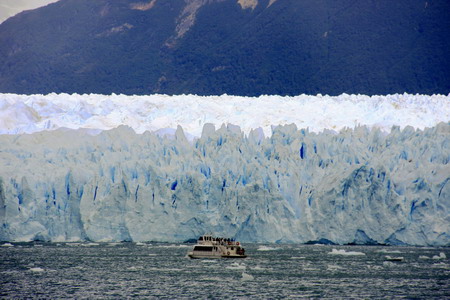
A general view of the leading edge of Perito Moreno glacier in the southern Patagonia region near El Calafate, January 3, 2009. While most of the world's glaciers are melting away because of warmer temperatures, scientists say the Perito Moreno ice field, known as "The White Giant", is gaining as much as 3 meters (10 feet) a day in some parts, pushed forward by heavy snowfalls in the Patagonia region. [Agencies]
|
"Glaciers don't respond solely to temperature changes," said Martin Stuefer, a Patagonian expert from the University of Alaska Fairbanks.
He said the area's heavy precipitation has apparently increased along with the world's recent climatic shifts, combining with strong, cold Patagonian winds to reinforce the glacier.
"Climate change is not the same everywhere," Stuefer said by telephone from Alaska.
The creaking Perito Moreno is one of the largest glaciers in South America and by far the most famous because it is so accessible to tourists despite its location about 3,000 km (1,900 miles) southwest of Buenos Aires.
Visitors crowd onto boats and viewing platforms to see the 30 km-long (18 mile-long) glacier noisily hurl huge blocks of blue-tinged ice into Lake Argentino.
Scientists say nearly 90 percent of the glaciers in Antarctica and Patagonia -- at the southern tip of South America -- are melting quickly. The same is happening in the Arctic, the Andes, the Alps, the Himalayas and elsewhere in response to climate change linked to human activity.
The average melting rate of the world's mountain glaciers has doubled since the year 2000, the U.N. Environment Programme and the World Glacier Monitoring Service said in a recent report.
Melting glaciers threaten to cause rising sea levels and dry up steady sources of fresh water that people now depend on for farming, drinking and even hydropower.
But glaciers are also affected by other factors such as snowfalls, winds, altitude and shade, and the Perito Moreno is among the few resisting the broad trend.
"A small percentage seems to be doing strange things," David Vaughan, a British Antarctic Survey glaciologist and member of the United Nations climate panel, said by telephone from a field mission in Antarctica. "The odd 13 percent are either stable or advancing a little."
There are limits to the Perito Moreno's aggressive advance, however. It periodically reaches as far forward as it can toward the Magallanes Peninsula and then sheds a large section of its front in a spectacular phenomena known as "la ruptura," or the rupture.
More than 190 governments have agreed to work out by the end of 2009 a new U.N. treaty to rein in fossil fuel emissions and slow global warming, fearing that rising seas could swamp low-lying islands or flood coastal cities from Amsterdam to Sydney.

