WORLD> America

|
WORLD> America
|
|
Exploiting nature to cut mosquitoes' life short
(Agencies)
Updated: 2009-01-02 16:46 WASHINGTON -- Old mosquitoes usually spread disease, so Australian researchers figured out a way to make the pests die younger -- naturally, not poisoned.
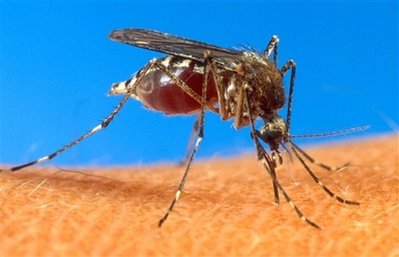
Once a mosquito encounters dengue or malaria, it takes roughly two weeks of incubation before the insect can spread that pathogen by biting someone, meaning older mosquitoes are the more dangerous ones. The Australian scientists knew that one type of fruit fly often is infected with a strain of bacterial parasite that cuts its lifespan in half. So they infected the mosquito species that spreads dengue fever -- called Aedes aegypti -- with that fruit-fly parasite, breeding several generations in a tightly controlled laboratory. Voila: Mosquitoes born with the parasite lived only 21 days -- even in cozy lab conditions -- compared to 50 days for regular mosquitoes, University of Queensland biologist Scott O'Neill reported in the journal Science. Mosquitoes tend to die sooner in the wild than in a lab. So if the parasite could spread widely enough among these mosquitoes, it "may provide an inexpensive approach to dengue control," O'Neill concluded. Theoretically, it could spread: This bacterium, called Wolbachia, is quite common among arthropod species, including some mosquito types -- just not the specific types that spread dengue and malaria, the researchers noted. And Wolbachia strains are inherited only through infected mothers, with an evolutionary quirk that can help them quickly gain a foothold in a new population. Next month, O'Neill's team begins longer studies in special North Queensland mosquito facilities that better mimic natural conditions to see how well the wMelPop strain persists as more mosquitoes are born, and what happens when they're exposed to dengue. "By killing old mosquitoes, wMelPop could thus impact on dengue transmission," Pennsylvania State University specialists Andrew Read and Matthew Thomas concluded in an editorial accompanying the work, which they called "a major step." It's possible that dengue viruses could evolve to incubate more rapidly if their mosquito hosts die younger, they noted, although that likely would be less of a problem than today's insecticide resistance. Still, "determining whether it can remove enough infectious mosquitoes to be useful will be a challenge," the duo cautioned. |