WORLD> Asia-Pacific

|
WORLD> Asia-Pacific
|
|
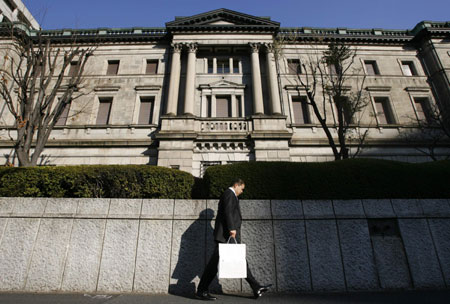
Japan central bank cuts interest rate to 0.1%
(Agencies)
Updated: 2008-12-19 13:46 Japan's central bank cut its key interest rate to 0.1 percent on Friday, joining the US Federal Reserve in lowering borrowing rates to nearly zero amid an ever-worsening outlook for the global economy.
The move was widely expected and comes after the government earlier in the day said it expected Japan's economy, the world's second-biggest, to shrink 0.8 percent for the fiscal year through March.
The central bank also introduced new steps to pump more money into the banking system to thaw a growing credit crunch. It plans to start buying commercial paper _ the short-term debt firms use to pay everyday expenses _ in an effort to funnel cash directly to companies and will increase its purchases of government bonds. In its most bearish assessment of the economy this year, Bank of Japan cited the harsh impact of tumbling exports, weakening domestic demand and job losses. "Under these circumstances economic conditions have been deteriorating and are likely to increase in severity for the immediate future," it said in its statement. Expectations for a rate cut jumped following the U.S. Federal Reserve's move earlier this week to reduce its benchmark rate to a range of zero to 0.25 percent _ the lowest level on record. But since then, the yen hit fresh 13-year highs against the dollar multiple times, heightening concerns about the strengthening yen, which erodes exporters' foreign income. On Wednesday in New York, the dollar fell to 87.11 yen, it's weakest level since July 1995. The Japanese currency's dramatic surge this week has triggered strong language on the political front, with government officials dropping hints at possible intervention to limit the yen's climb and protect Japanese exporters. Major manufacturers like Toyota Motor Corp. and Sony Corp., which are also facing slowing demand overseas, have been cutting employees and slashing production. The Nikkei, Japan's top business daily, reported Friday that Toyota's mainstay vehicle operations are likely to post their first loss for the fiscal year through March 2009. The grim conditions facing Japan Inc. were underscored Monday in the Bank of Japan's "tankan" report, which showed that business confidence among big manufacturers fell at its fastest pace in 34 years. The quarterly survey also revealed that companies were having trouble raising money amid as credit tightens. "The credit crunch is spreading its tentacles in Japan after being considered a foreign problem until the middle of this year," said Goldman Sachs' chief Japan economist Tetsufumi Yamakawa in a report Thursday. The government's latest forecast released projects Japan's economy to shrink this fiscal year and manage only flat growth the following year. Earlier this month, the government said Japan fell deeper into recession in the third quarter than first thought, shrinking at an annual pace of 1.8 percent. Market observers were awaiting comments by Bank of Japan Gov. Masaaki Shirakawa later in the afternoon. Shirakawa has repeatedly stated that pushing interest rates even closer toward zero would discourage banks from lending, but his comments this week have reflected a new sense of crisis. Speaking before the Diet on Tuesday, Shirakawa described current economic conditions as the worst since the Great Depression of the 1930s. |