WORLD> Asia-Pacific

|
WORLD> Asia-Pacific
|
|
Japan struggles to give homegrown food a boost
(Agencies)
Updated: 2008-12-09 07:46
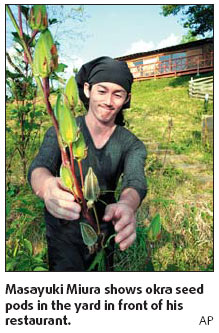
Masayuki Miura's restaurant is radically out of step with modern Japanese tastes. No Australian beef hamburgers, no mountains of fried Brazilian chicken, no imported steaks. Not a Chinese cabbage in sight. Instead, Miura and his wife, Yoko, serve up a 100 percent made-in-Japan offering of fish and locally grown organic rice and vegetables. "We need more people to eat Japanese vegetables," declared Miura, whose restaurant overlooks his almost 2-hectare farm in western Japan. "Of course, it's a food culture issue. Hamburgers don't have Japanese vegetables in them." No, they don't - and many in Japan consider that a major problem. The Japanese on average get only 40 percent of their calories from domestic food, down from 73 percent in 1965, the government says. The US, an agricultural exporter, has a 128 percent rate. Amid rising world food prices and a series of imported food contamination scandals, Japan is afraid it is too reliant on foreign food. The government released a report last year showing what Japanese would have to eat without imports. The typical lunch: One potato, two sweet potatoes and a quarter of an apple. "We have to wonder whether Japan should continue buying up food from around the world," said Hidenobu Ogawa, a food safety official with the Agriculture Ministry. "Japan has economic power now. But if we lose strength in the future, can we get enough food to survive?" The government has set a target of boosting the self-sufficiency rate up to 45 percent by 2015, and has launched a series of campaigns - from open markets featuring Japanese foods to commercials urging people to eat more rice. Miura's farm illustrates the kind of agricultural revolution needed to significantly boost self-sufficiency. Miura and his wife Yoko started their project a decade ago by going from farm to farm collecting samples and seeds of heirloom vegetables. The research turned up mild purple chili peppers, red okra, and a plethora of tubers, such as the carrot-shaped "yamato" potato, and the "busho" potato. The Miuras now grow some 200 varieties of vegetables and fruits. They produce natural fertilizer by composting leftovers from the restaurant and collecting waste from their three goats. While the Miuras think their experiment is unique in Japan, it dovetails with many other local produce and organic farming projects that have cropped up around Japan in recent years. "I think we're entering a phase when the Japanese are trying to preserve their own types of food," Miura said. "You can't separate the issues of food self-sufficiency and food culture." |