WORLD> America

|
WORLD> America
|
|
US autos in vehement fight to survive
(chinadaily.com.cn/Agencies)
Updated: 2008-11-19 11:52
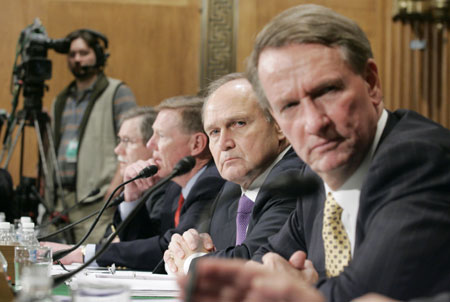
Facing a daunting job to survive, the Big Three automakers of the United States have gone to Washington DC to beg for emergency federal aid, as the economic crisis is churning more wildly to take its toll. The heads of the Big Three automakers of Detroit pleaded Tuesday for urgent lifeline to stave off eventual collapse. However, after four hours of testimony at the Capitol Hill, it seemed they had not persuaded enough lawmakers to move quickly on a government bailout. Worries are on the rise that if the Big Three are left on their own to fight for life in the coming months, one or more could go under, setting off a new round of dreadful economic woes, on a scale even bigger than the collapse of the Lehman Brothers in late September. And, any escalation of the economic crisis in America could have very negative ramifications on other countries, including China. US Senate Democratic leaders said they had not been able to muster the support for legislation that would provide US$25 billion taxpayers' money to the troubled Big Three from the Treasury Department's $700 billion economic rescue fund. The frantic bid from Detroit for help was laid bare at a packed hearing of the Senate banking committee, in which two of the three automakers said they might run out of money by the end of 2008. The cause of the American Big Three's misfortunes was not management mistakes, they claimed, but the anemic American economy and the inability of consumers to obtain credit to buy cars. The chief executives of both General Motors and Chrysler said their companies were using up their cash at a rate that could leave them close to insolvency in a short time. GM chairman and CEO, Rick Wagoner warned that the rippling impact of the auto industry's cash woes could put 3 million American jobs at peril. He cautioned that a failure by GM, Ford or Chrysler would rapidly bring the entire domestic industry down. "The societal costs would be catastrophic - three million jobs lost within the first year, US personal income reduced by $150 billion and a government tax loss of more than $156 billion over three years," Wagoner said at the testimony. Despite the urgent tone of the auto executives, lawmakers in both parties saw little chance that a bailout could be put together and passed during the current lame-duck session. The Bush administration has steadfastly refused requests by Democratic leaders to tap into the financial rescue program to aid the automakers. Henry Paulson, the US Treasury secretary , at a House hearing on Tuesday morning and again at a lunch with Republican senators, implored lawmakers to oppose using any of the $700 billion financial bailout for the auto companies, which he said would set a dangerous precedent. The White House instead has pushed for the auto companies to get immediate access to $25 billion in previously approved loans to retool production plants to make fuel-efficient vehicles. The suddenness of the cash crisis at G.M. has caught Washington by surprise and raised doubts that the largest American automaker can survive long term. The hearing underscored how deeply complicated the problems are at the Big Three, which have been losing billions of dollars even as they close factories and cut tens of thousands of jobs. It also stirred fresh criticisms of Detroit's ability to compete in the global marketplace. Several senators called into question the carmakers' vehicle quality, high labor costs and the capability of their senior management. Senator Christopher Dodd, who is chairman of the banking committee and has been generally supportive of aid to the auto companies, gave little solace to the Detroit executives. "Their discomfort in coming to the Congress with hat in hand is only exceeded by the fact that they are seeking treatment for wounds that are to a large extent self-inflicted," he said. "No one can say they didn't see this coming to them." But the auto executives argued that their turnaround strategies were taking hold just as the economy faltered and available credit dried up for consumers. The overall United States vehicle market has fallen 14.8 percent through the first 10 months of the year. However, sales in October plummeted 31.9 percent, mostly because of the lack of available credit for potential car buyers. With sales and revenues dropping sharply, GM, Ford and Chrysler have been digging deep into their cash reserves to pay employees and suppliers. G.M., which is burning through more than $2 billion a month, could fall below the minimum levels of cash needed to run the company by January. |