WORLD> Asia-Pacific

|
WORLD> Asia-Pacific
|
|
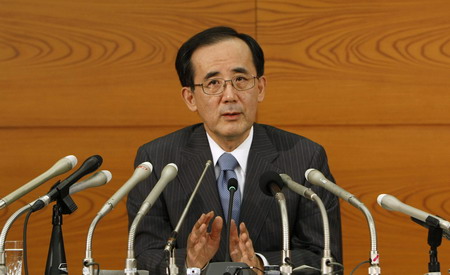
Bank of Japan cuts key interest rate
(Agencies)
Updated: 2008-10-31 15:19 TOKYO -- The Bank of Japan voted Friday to cut its key interest rate for the first time in more than seven years, finally joining central banks around the world in trimming borrowing costs to cushion the impact of the global financial crisis.
The Bank of Japan policy board voted in a rare 4-4 split decision to reduce the uncollateralized overnight call rate to 0.3 percent, the lowest among major economies. Gov. Masaaki Shirakawa, who has the final say in the event of a tie, voted in favor of a rate cut. However, Japan's benchmark Nikkei stock index closed down 5 percent Friday after the central bank's smaller-than-expected cut in its key interest rate.The Nikkei 225 index lost 452.78 points to close at 8,576.98 points. The central bank, operating with one vacancy on its nine-member board, last loosened monetary policy in March 2001. "Adjustments in the world economy stemming from financial crises in the United States and Europe have further increased in severity," the Bank of Japan said in its statement. "Under these circumstances, increased sluggishness in Japan's economic activity will likely remain over the next several quarters with exports leveling off and the effects of earlier increases in energy and materials prices persisting." The move comes two days after the US Federal Reserve slashed its key rate by half a percentage point to 1 percent, a level seen only once before in the last half century. Earlier this week, South Korea's central bank lowered rates by three-quarters of a point, its biggest cut ever, to 4.25 percent. China, China's Hong Kong Special Administrative Region and Taiwan Province also reduced rates this week. Many analysts are also expecting the European Central Bank to cut its key rate, now at 3.75 percent, when its policy panel meets on Nov. 6. Investor hopes for a rate cut intensified this week after The Nikkei financial daily reported Wednesday that the central bank was mulling a policy shift. The speculation reigned in a recently surging yen and helped fuel a rally in Japan's stock market, where the Nikkei index jumped nearly 10 percent Thursday. Despite the global financial crisis, a faltering domestic economy and extreme market volatility, the Bank of Japan had until now left monetary policy untouched, reiterating its long-held stance that the world's second-largest economy faced both upside and downside risks. The bechmark rate had stood at 0.5 percent since February 2007. The Bank of Japan "judged that a reduction in policy interest rates and a further increase in the flexibility of money market operations were necessary to maintain accommodative financial conditions," it said. In addition to reducing interest rates, the policy board voted to enact credit-easing measures including a temporary facility to pay 0.1 percent interest on commercial banks' excess reserves deposited at the Bank of Japan "in order to further facilitate the provisioning of sufficient liquidity toward the year-end and fiscal year-end." It also lowered its basic loan rate, at which financial institutions directly borrow from the BOJ, to 0.5 percent from 0.75 percent. The central bank's actions Friday follow a series of weak economic data recently, as well as evidence earlier Friday that inflation was slowing. For the July-September period, industrial output fell 1.2 percent from the previous three months in its third straight quarter of declines, and production is expected to drop 2.3 percent in October and 2.2 percent in November. Core inflation, which excludes fresh food prices, jumped 2.3 percent during the month from a year earlier on still-high fuel and food costs, according to the Ministry of Internal Affairs and Communications. Although the result marks the 12th consecutive month of increase for the core consumer price index, it is slower than August's 2.4 percent rise. Fuel costs in particular are cooling, with gasoline prices rising 20.7 percent in September, down from 26.4 percent in August. "As for prices, consumer price inflation is likely to decline gradually reflecting the recent fall in commodity prices, although it remains relatively high to date," the central bank said. Economists and market observers now await the central bank's Semiannual Economic Outlook to be released in the afternoon, as well as comments by Shirakawa. |