WORLD> Asia-Pacific

|
WORLD> Asia-Pacific
|
|
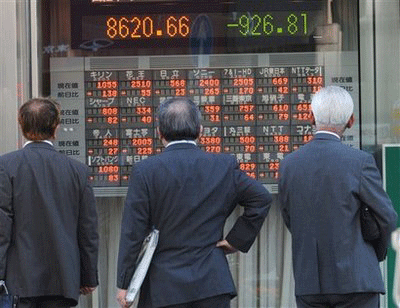
Asian markets tumble; Nikkei falls 11 percent
(Agencies)
Updated: 2008-10-16 17:05 HONG KONG - Asian stocks tumbled Thursday, with Tokyo's market plunging more than 11 percent, after another dive on Wall Street as worse-than-expected data about the US economy heightened fears of a global recession.
Japanese Prime Minister Taro Aso blamed the renewed drop in markets on an "insufficient" US bailout plan totaling $700 billion. "Since it was insufficient, the market is again falling sharply," Aso told lawmakers. He did not elaborate. Tokyo's Nikkei 225 stock average slid 1,089.02 points, or 11.41 percent, to 8,458.45, its biggest one-day drop since the stock market crash of October 1987. In South Korea, the main index dropped 9.25 percent after Standard & Poor's said it may downgrade the credit ratings of seven of the country's major banks. The ratings agency warned the credit crisis could make it difficult for the companies to refinance maturing debt. Every other key index was deep in the red, with Hong Kong off 6.2 percent, Australia down 6.7 percent and Singapore losing 7.3 percent. Investors were unnerved by US data showing the country's retail sales fell 1.2 percent in September, almost double the 0.7 percent decline analysts expected -- clear evidence that consumer spending, which accounts for more than two-thirds of US economic activity, was weakening. That was followed by more bearish data from the US Federal Reserve that showed the economy continued to slow in the early fall as financial and credit market problems took a turn for the worse. All told, the readings provided some of the most ominous signs to date that the world's largest economy -- a critical export market for Asia -- was sliding into recession, if not already in one. "Sentiment is deteriorating very fast. People are losing what little confidence they have on a day-by-day basis," said Jacky Choi, a Hong Kong-based fund manager at Value Partners Ltd., which manages about $5 billion in Asia. "Everyone is very worried about the economy in the U.S and around the world." In New York on Wednesday, the Dow Jones industrial average ended down 733.08, or 7.87 percent, at 8,577.91 -- its second-biggest point loss ever. The massive selling accelerated as US Federal Reserve Chairman Ben Bernanke warned in a speech Wednesday that patching up the credit markets won't provide an instantaneous jolt to the economy. Fears about the outlook for the world economy have overtaken the relief the markets breathed at the start of the week on the unveiling of a series of bank rescue packages from governments around the world. On Tuesday, the US government followed Europe's lead and announced it will pump some $250 billion into shares of its leading banks, including JP Morgan Chase & Co., Bank of America Corp., Goldman Sachs Inc. and Citigroup Inc. That money is part of the $700 billion in public funds the US government will use to buy bad mortgage-related securities and loans from troubled financial institutions. The panic selling in Asia hit many sectors. Export-linked shares such as top Japanese automaker Toyota Motor Corp., which was off 5.8 percent, retreated on worries about declining US demand. Resource firms slumped along with global commodity prices, with BHP Billiton Ltd., the world's largest mining company, losing 13 percent. In financials, KB Financial Group Inc., the holding company for top South Korean lender Kookmin Bank, lost almost 15 percent. The market tailspin helped support lending rates Thursday, showing that banks were still scared to lend money to one another -- one of the core problems of the financial crisis. The Hong Kong interbank offered rate, known as Hibor, for three-month loans ticked up slightly to 4.35 percent after easing the past couple of days. Meanwhile, insurance policies against companies failing to make good on their debt, known as credit default swaps, were more expensive -- a signal that firms believe the risk of default is growing. Oil prices continued to fall. Light, sweet crude for November delivery slid $2.43 to $72.11 in Asian trade on the New York Mercantile Exchange. Overnight, the contract fell $4.09, or 5.2 percent, to settle at $74.54 a barrel. The US dollar edged up to 100.15 yen. The euro fell to $1.3380. The South Korean won plunged 9.7 percent to 1,373 to the US dollar. South Korea's currency has fallen 31.8 percent so far this year.
|