WORLD> America

|
WORLD> America
|
|
Congress, White House reach financial bailout deal
(Agencies)
Updated: 2008-09-28 13:41
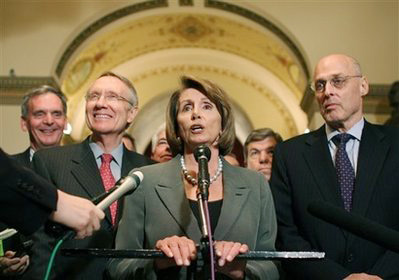
WASHINGTON - US Congressional leaders and the Bush administration reached a tentative deal early Sunday on a landmark bailout of imperiled financial markets whose collapse could plunge the nation into a deep recession. House Speaker Nancy Pelosi announced the $700 billion accord just after midnight but said it still has to be put on paper. "We've still got more to do to finalize it, but I think we're there," said Treasury Secretary Henry Paulson, who also participated in the negotiations in the Capitol. "We worked out everything," said Sen. Judd Gregg, R-N.H., the chief Senate Republican in the talks. Congressional leaders hope to have the House vote on the measure Monday. A Senate vote would come later. The plan calls for the Treasury Department to buy deeply distressed mortgage-backed securities and other bad debts held by banks and other investors. The money should help troubled lenders make new loans and keep credit lines open. The government would later try to sell the discounted loan packages at the best possible price. At the insistence of House Republicans, some money would be devoted to a program that would encourage holders of distressed mortgage-backed securities to keep them and buy government insurance to cover defaults. The legislation would place "reasonable" limits on severance packages for executives of companies that benefit from the rescue plan, said a senior administration official who was authorized to speak only on background. It would affect fired executives of financial firms, and executives of firms that go bankrupt. Some of the provisions would be retroactive and some prospective, the official said. Also, the government would receive stock warrants in return for the bailout relief, giving taxpayers a chance to share in financial companies' future profits. To help struggling homeowners, the plan would require the government to try renegotiating the bad mortgages it acquires with the aim of lowering borrowers' monthly payments so they can keep their homes. The measure's main elements were proposed a week ago by the Bush administration, with Paulson heading efforts to push it through the Democratic-controlled Congress. Democrats insisted on greater congressional oversight, more taxpayer protections, help for homeowners facing possible foreclosure, and restrictions on executives' compensation. To some degree, all those items were added. At the insistence of House Republicans, who threatened to sidetrack negotiations at midweek, the insurance provision was added as an alternative to having the government buy distressed securities. House Republicans say it will require less taxpayer spending for the bailout. But the Treasury Department has said the insurance provision would not pump enough money into the financial sector to make credit sufficiently available. The department would decide how to structure the insurance provisions, said Sen. Kent Conrad, D-N.D., one of the negotiators. Money for the rescue plan would be phased in, he said. The first $350 billion would be available as soon as the president requested it. Congress could try to block later amounts if it believed the program was not working. The president could veto such a move, however, requiring extra large margins in the House and Senate to override. Despite the changes made during an intense week of negotiations, the heart of the program remains Bush's original idea: To have the government spend billions of dollars to buy mortgage-backed securities whose value has plummeted as hundreds of thousands of Americans have defaulted on their home loans. Senate Majority leader Harry Reid, D-Nev., said Saturday that the goal was to come up with a final agreement before the Asian markets open Sunday night. "Everybody is waiting for this thing to tip a little bit too far," he said, so "we may not have another day." Hours later, when he and others told reporters of the plan in a post-midnight news conference, Reid referred to the sometimes testy nature of the negotiations. "We've had a lot of pleasant words," he said, "and some that haven't always been pleasant." "We're very pleased with the progress made tonight," said White House spokesman Tony Fratto. "We appreciate the bipartisan effort to deal with this urgent issue." It was not immediately clear how many House Republicans might vote for the measure. With the election five weeks away, Democrats have said they would not push a plan that appeared sharply partisan in nature.
|