WORLD> America

|
WORLD> America
|
|
US radical bailout plan has a jawdropping price tag
(Agencies)
Updated: 2008-09-20 09:20
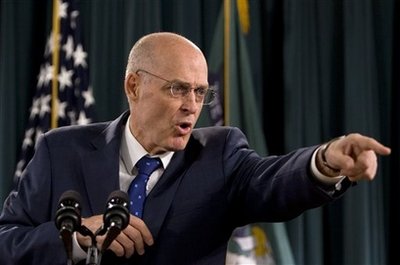
"This is a pivotal moment for America's economy," Bush said. "In our nation's history, there have been moments that require us to come together across party lines to address major challenges. This is such a moment." Congressional leaders of both parties welcomed the administration's bold moves, after a series of ad hoc rescues. The talk on the presidential campaign trail, barely six weeks before the election, was of bipartisanship, too. Democrat Barack Obama said it was critical that leaders in both parties work in concert. "Truly, we are all in this together," he said. GOP presidential nominee John McCain said leaders should put aside partisan differences and "any action should be designed to keep people in their homes and safeguard the life savings of all Americans." The federal government already has pledged more than $600 billion in the past year to bail out, or help bail out, some of the biggest names in American finance. That includes the rescue of investment bank Bear Stearns in March, the takeover of mortgage giants Fannie Mae and Freddie Mac earlier this month and the takeover of the world's largest insurance company, American International Group, just this week. But the contagion continued to spread, bringing political consensus that drastic and comprehensive federal action was needed. There are precedents for such a federal takeover. In the late 1980s, the government created the Resolution Trust Corporation to tackle the savings and loan crisis. It acquired the defaulted mortgages, foreclosed real estate and other assets of nearly a thousand failed S&Ls, restoring order and stability to the system. Resolving that crisis took six years and $125 billion in taxpayer money — roughly equal to $200 billion in today's dollars. And there was the Reconstruction Finance Corporation, a Depression-era relief program formed in 1932 by President Hoover that tried to revive the market by giving loans to banks and other businesses. On Friday, Treasury Secretary Henry Paulson gave few details about the structure of the new program. Asked about an overall price tag, he said, "hundreds of billions" of dollars. Congressional leaders said they were ready to move quickly but still needed details of the administration plan. For instance, there was no indication of what the government would get in return from financial companies for the federal assistance. Paulson and Federal Reserve Chairman Ben Bernanke briefed lawmakers in both parties on the idea by conference call Friday. In a session with House Democrats, they described a plan where the government would in essence set up reverse auctions, putting up money for a class of distressed assets — such as loans that are delinquent but not in default — and financial institutions would compete for how little they would accept for the investments, said Rep. Brad Sherman, D-Calif., who participated in the call. |