WORLD> Europe

|
WORLD> Europe
|
|
Stripped of planet status, Pluto saves face
(Agencies)
Updated: 2008-06-12 22:59 PARIS - Two years after Pluto was struck from the planetary A-list and downgraded to "dwarf-planet" status, the ninth rock from the Sun regained some dignity Thursday by lending its name to a new category of celestial bodies.
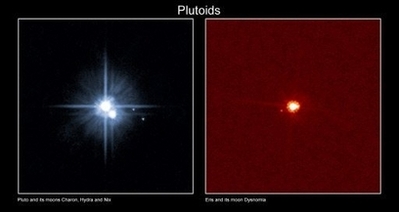
In a revised taxonomy of the mainly lifeless objects circling the Sun, those fulfilling all the criteria of planets except one -- the ability to "clear the neighborhood" around their orbit -- will now be called "plutoids", the International Astronomical Union (IAU) announced. If, that is, they are further from the Sun than Neptune, which became the outermost planet in our solar system after Pluto was stripped of its planetary stripes. Neptune orbits the Sun once every 164.8 years at a distance of 4.5 billion kilometres (2.8 billion miles). Besides Pluto, the second known and named plutoid is called Eris. Increasingly powerful tools for exploring the outer boundaries of the Solar System insure that others will be found, astronomers say. After an impassioned debate -- and over the strenuous objections of many astronomers and star gazers -- the IAU declassified Pluto as a full-fledged planet in August 2006. Along with Erin and a third wannabe planet, Ceres, nestled in the asteroid belt between Mars and Jupiter, Pluto was provisionally given the status of "dwarf-planet" pending today's decision on nomenclature. Ceres, because it is closer to the Sun than Neptune, will remain a dwarf-planet. All three categories -- planet, dwarf-planet and plutoid -- share two core characteristics, the 10,000-strong astronomical association decided. They are celestial bodies that are in orbit around our Sun, and they have sufficient mass such that self-gravity can overcome what are called "rigid body forces" to assume a nearly spherical shape. But only those orbiting masses that can also sweep other celestial bodies from the area around their orbits can be considered as genuine planets. The change of definition left eight planets, counting outward from the Sun: Mercury, Venus, Earth, Mars, Jupiter, Saturn, Uranus, and Neptune. Pluto is 2,274 kilometres (1,413 miles) in diameter and 5.9 billion kilometres (3.7 billion miles) from the Sun. It takes 247.7 Earth years to complete an orbit, and has one large moon and two small ones. In Spanish and French, the new category of dwarf-planet will be called "plutoide". The IAU has been responsible for naming planetary bodies and their satellites since the early 1900s. |