WORLD> Odd News

|
WORLD> Odd News
|
|
Scientists find monkeys who know how to fish
(Agencies)
Updated: 2008-06-10 23:21 BANGKOK - Long-tailed macaque monkeys have a reputation for knowing how to find food - whether it be grabbing fruit from jungle trees or snatching a banana from a startled tourist.
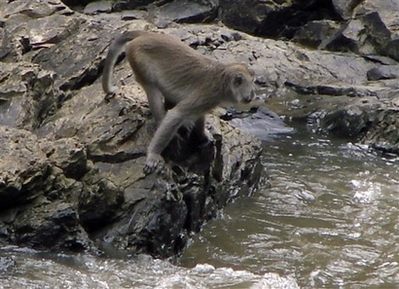
Now, researchers say they have discovered groups of the silver-haired monkeys in Indonesia that fish. Groups of long-tailed macaques were observed four times over the past eight years scooping up small fish with their hands and eating them along rivers in East Kalimantan and North Sumatra provinces, according to researchers from The Nature Conservancy and the Great Ape Trust. The species had been known to eat fruit and forage for crabs and insects, but never before fish from rivers. "It's exciting that after such a long time you see new behavior," said Erik Meijaard, one of the authors of a study on fishing macaques that appeared in last month's International Journal of Primatology. "It's an indication of how little we know about the species." Meijaard, a senior science adviser at The Nature Conservancy, said it was unclear what prompted the long-tailed macaques to go fishing. But he said it showed a side of the monkeys that is well-known to researchers - an ability to adapt to the changing environment and shifting food sources. "They are a survivor species, which has the knowledge to cope with difficult conditions," Meijaard said Tuesday. "This behavior potentially symbolizes that ecological flexibility." The other authors of the paper, which describes the fishing as "rare and isolated" behavior, are The Nature Conservancy volunteers Anne-Marie E. Stewart, Chris H. Gordon and Philippa Schroor, and Serge Wich of the Great Ape Trust. Some other primates have exhibited fishing behavior, Meijaard wrote, including Japanese macaques, chacma baboons, olive baboons, chimpanzees and orangutans. Agustin Fuentes, a University of Notre Dame anthropology professor who studies long-tailed macaques, or macaca fascicularis, on the Indonesian island of Bali and in Singapore, said he was "heartened" to see the finding published because such details can offer insight into the "complexity of these animals." "It was not surprising to me because they are very adaptive," he said. "If you provide them with an opportunity to get something tasty, they will do their best to get it." Fuentes, who is not connected with the published study, said he has seen similar behavior in Bali, where he has observed long-tailed macaques in flooded paddy fields foraging for frogs and crabs. He said it affirms his belief that their ability to thrive in urban and rural environments from Indonesia to northern Thailand could offer lessons for endangered species. "We look at so many primate species not doing well. But at the same time, these macaques are doing very well," he said. "We should learn what they do successfully in relation to other species." Still, Fuentes and Meijaard said further research was needed to understand the full significance of the behavior. Among the lingering questions are what prompted the monkeys to go fishing and how common it is among the species. Long-tailed macaques were twice observed catching fish by The Nature Conservancy researchers in 2007, and Wich spotted them doing it two times in 1998 while studying orangutans. |