
White House denies Bush stifling dissent on Iran
Updated: 2008-03-13 08:43
WASHINGTON - The White House denied on Wednesday that President George W. Bush was stifling dissenting views in the military after the resignation of a top commander reported to have been at odds with his hard-line policy on Iran.
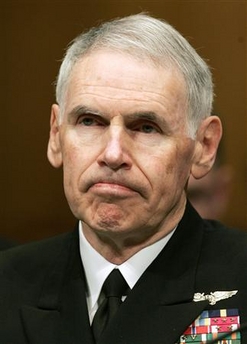 Commander of the U.S. Central Command Navy Adm. William Fallon testifies before the Senate Armed Services Committee hearing on Capitol Hill in Washington in this March 4, 2008 file photo. [Agencies] |
Adm. William Fallon, the senior U.S. commander for the Iraq and Afghanistan wars, insisted on Tuesday he did not disagree with the Bush administration over Iran, but that perceptions of a rift made it difficult for him to continue doing his job.
Bush's Democratic critics quickly seized on Fallon's departure as another sign that the White House refused to tolerate military officers who spoke their mind.
Among the main complaints about the 2003 invasion of Iraq and the conduct of the war is that the administration ignored dissenting advice from the U.S. military that might have avoided mistakes.
"That is absolutely nonsense because President Bush has always fostered an environment of robust and healthy debate," White House spokeswoman Dana Perino told reporters when asked whether Bush was trying to quash differing viewpoints.
Administration officials also dismissed the notion Fallon's abrupt departure meant the United States was any closer to military action against Iran, which is embroiled in disputes with Washington over Iraq and Tehran's nuclear program.
"The president has made very clear that the United States believes that a diplomatic solution on the Iran issue is possible if the world stays strong and reacts in a unified way," Secretary of State Condoleezza Rice told reporters.
|
Related readings: |

Republican presidential candidate John McCain, who will be the party's nominee, told reporters on his campaign bus ride from New Hampshire to Boston that he knew there had been some tensions between Fallon and the military or civilian leadership but did not know the details of why he retired.
Still, he said, Fallon "is entitled to his views" on Iran even if they conflict with the prevailing opinion in the U.S. government.
OUT OF STEP?
Over the past year, Bush and Vice President Dick Cheney have ratcheted up the rhetoric against Iran, which is defying international demands to halt uranium enrichment.
Washington says such activities could easily be turned to bomb-building. Tehran says its nuclear purposes are peaceful.
"That all options are on the table is what helps make diplomacy work and make it more effective," Perino said.
Fallon, the commander of U.S. forces in the Middle East, had made several comments that seemed to show him at least partly out of step with the administration. The most recent were included in an Esquire magazine article titled "The Man Between War And Peace" that described him as challenging the White House and urging restraint on Iran.
Fallon cooperated with the author during the article's preparation but strongly criticized it after it appeared.
Fallon also denied reports he had a testy relationship with Army Gen. David Petraeus, the top commander in Iraq and a White House favorite. Fallon, according to news reports, may have favored a faster pullback from Iraq than Petraeus wants.
Perino said the root of the problem was a misperception Fallon was at odds with the administration.
"When it comes to foreign policy, it's critical that an administration speak with one voice, and if there is a perception that they're not speaking with one voice, then that becomes a problem," she said.
Senate Democratic leader Harry Reid of Nevada, a critic of Bush's strategy in the unpopular war in Iraq, called Fallon's resignation "yet another example that independence and the frank, open airing of experts' views are not welcomed in this administration."
Democratic presidential candidate Barack Obama said it was counterproductive to "rattle sabres" on Iran and he was not surprised Fallon's views were not compatible with a White House "that has generally wanted people to toe the line."
|
|
|
||
|
||
|
|
|
|