Stock markets plunge worldwide
Updated: 2008-01-22 11:44
LONDON -- Stocks fell sharply worldwide Monday following declines on Wall Street last week amid investor pessimism over the US government's stimulus plan to prevent a recession.
|
|
US markets were closed for Martin Luther King Jr. Day, but the downbeat mood from last week's market declines there circled through Europe, Asia and the Americas.
Investors dumped shares because they were skeptical that an economic stimulus plan President Bush announced Friday would shore up the economy that has been battered by problems in its housing and credit markets. The plan, which requires approval by Congress, calls for about $145 billion worth of tax relief to encourage consumer spending.
"It's another horrible day," said Francis Lun, a general manager at Fulbright Securities in Hong Kong. "Today it's because of disappointment that the US stimulus (package) is too little, too late and investors feel it won't help the economy recover."
On Monday, Britain's benchmark FTSE-100 slumped 5.5 percent to 5,578.20, France's CAC-40 Index tumbled 6.8 percent to 4,744.15, and Germany's blue-chip DAX 30 plunged 7.2 percent to 6,790.19.
|
|||


In Canada, the S&P/TSX composite index on the Toronto Stock Exchange fell 4.8 percent. Brazilian stocks plunged 6.6 percent on the main index of Sao Paulo's Bovespa exchange, and Argentina's benchmark Merval index fell 6.3 percent to close under 1,900 for the first time since August 2006.
"We've taken our lead from the Asian markets who have not been impressed by the US. There's debate if there's going to be a recession in the US I don't think there's much chance of that though," said Richard Hunter, an analyst at Hargreaves Lansdown Stockbrokers Ltd. in London.
Concerns about the outlook for the US economy, a major export market for Asian companies, have sent the region's markets sliding in 2008. Just last Wednesday, the Hang Seng index sank 5.4 percent.
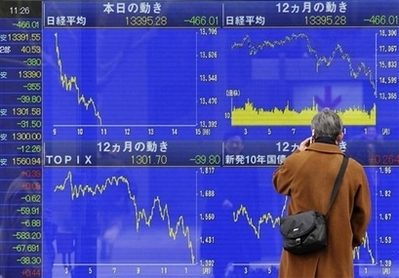
Japan's benchmark Nikkei 225 index slid 3.9 percent to close at 13,325.94 points, its lowest close in more than two years. China's Shanghai Composite index plunged 5.1 percent, partly on worries about mainland Chinese banks' exposure to risky US mortgage investments.
"People are certainly nervous about a potential recession in the US spilling over to the rest of the world," said David Cohen, Director of Asian Economic Forecasting at Action Economics in Singapore.
Cohen said there may be "still some wariness" about politicians being able to come up with a compromise and act sufficiently quickly on a stimulus package. "I think the impact would be marginal anyway," he said.
Investors took cues from the negative reaction to the US president's plan on Wall Street on Friday, when the Dow Jones industrial average slid 0.5 percent to 12,099.30, bringing its loss for the year so far to nearly 9 percent.
Traders also have shrugged off assurances from Federal Reserve Chairman Ben Bernanke that the US central bank is ready to act aggressively -- which means a likely big interest rate cut later this month -- to help the sagging economy.
Some analysts predict that Asia won't suffer dramatically from a US recession because increased trade and investment within Asia has made the region less reliant on the United States than in the past. Excluding Japan, 43 percent of Asia's exports go to other nations in the region, Lehman Brothers calculates, up from 37 percent in 1995.
But on Monday, uncertainty and pessimism reigned.
In Tokyo trading, exporters got hit hard, partly because of the yen's recent strength against the dollar. Toyota Motor Corp. lost 3.3 percent and Honda Motor Co. sank 3.4 percent.
Shares of Bank of China dropped 6.4 percent in Hong Kong after the South China Morning Post newspaper reported that the bank is expected to announce a "significant write-down" in US subprime mortgage securities, citing unidentified sources. In Shanghai, the bank's stock declined 4.1 percent.
India's benchmark Sensex index fell 1,353 points, or 7.4 percent -- its second-biggest percentage drop ever -- to 17,605.35 points. At one point, it was down nearly 11 percent.
The decline hit companies across the board, with power utility Reliance Energy Ltd. falling 16.4 percent. Major software company Tata Consultancy Services Ltd. slid 7.6 percent
"A gloomy US climate has affected the global markets. Even if those markets recover, it will take sometime for the recovery to reach India because today's fall has been so drastic," said Jayant Pai, of the Mumbai investment company IL&FS Ltd.
Still, Pai and others suggested that the declines could lead to a buying opportunity.
"The sell-off today takes us close to the bottom," she said.
Since the start of the year, Japan's Nikkei index has declined 13 percent, while Hong Kong's blue-chip index is down more than 14 percent. Even China's Shanghai index -- which nearly doubled last year -- has fallen 6.6 percent over the same period and nearly 20 percent from its all-time closing high on Oct. 16.
|
|
|
||
|
||

|
|
|
|