Brain says to spine 'heal thyself': study
Updated: 2008-01-08 07:40
PARIS - Tiny nerves crisscrossing the spine can bypass crippling injuries recently written off as irreversible, scientists reported in a study published Monday.
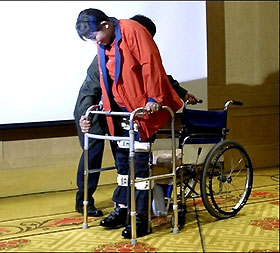 A paralysed patient tries to walk with the help of a walking frame. Scientists have said that tiny nerves crisscrossing the spine can bypass crippling injuries recently written off as irreversible. [Agencies] |
Experiments conducted on mice at the University of California in Los Angeles showed for the first time that the central nervous system can rewire itself to create small neural pathways between the brain and the nerve cells that control movement.
This startling discovery could one day open the way to new therapies for damaged spinal cords and perhaps address conditions stemming from stroke and multiple sclerosis, according to the study.
Normally, the brain relays messages that control walking or running via neural fibers called axons.
When these long nerves are crushed or severed -- in a road crash or sports accident, for example -- these lines of communication are cut, resulting in reduced movement or paralysis.
"Not long ago, it was assumed that the brain was hard-wired at birth and that there was no capacity to adapt to damage," explained neurobiologist Michael Sofroniew, who led the research.
But the new findings add to a growing evidence of the brain's remarkable capacity to reorganise in response to injury "in ways that were not thought possible," he told AFP.
Sofroniew compared the axons to major freeways running from the brain to the lower spinal cord.
"When there is a traffic accident on the freeway, what do drivers do? They take shorter surface streets," he said.
In the same way, the short nerves found up and down the spinal cord, called propriospinal connections, set up alternate routes.
"These detours aren't as fast or direct, but still allow drivers to reach their destinations," he said, completing the metaphor.
In the experiments, Sofroniew and his colleagues blocked half of the long axon nerve fibers in mice in different places, and at different times, on either side of the spinal cord, paralysing the animals' hind legs.
They left untouched the spinal cord's core, which contains the shorter nerves.
Astonishingly, most of the mice regained control of their legs within eight weeks, albeit with less mobility than before.
When the researchers blocked then shorter propriospinal nerves, the mice were once again paralysed, proving that they had been responsible for the recovered mobility.
The challenge for medicine will be finding ways to enhance and harness this spontaneous neural rewiring to help heal spinal cord injuries.
Up to now, most experts believed that the only way for injured patients to walk again was to regrow the long axon, but it has been extremely difficult to get these damaged "highways" to regenerate more than a short distance.
"The next goal is to determine how to maximise the process through the right kind of rehabilitation and training, and to test whether there are any forms of pharmacologic stimulation that might help as well," said Sofroniew.
More than a quarter of million people in the United States suffer from spinal cord injury, with some 10,000 new cases every year, according to epidemiological studies. Worldwide, the rate of new cases is between 15 and 40 cases per million every year.
|
|
|
||
|
||
|
|
|
|