Intel centers losing anti-terror focus
Updated: 2007-11-29 11:40
WASHINGTON - Local intelligence-sharing centers set up after the Sept. 11, 2001, attacks have had their anti-terrorism mission diluted by a focus on run-of-the-mill street crime and hazards such as hurricanes, a government report concludes.
Of the 43 "fusion centers" already established, only two focus exclusively on preventing terrorism, the Government Accountability Office found in a national survey obtained by The Associated Press. Center directors complain that they were hampered by lack of guidance from Washington and they were flooded by often redundant information from multiple computer systems.
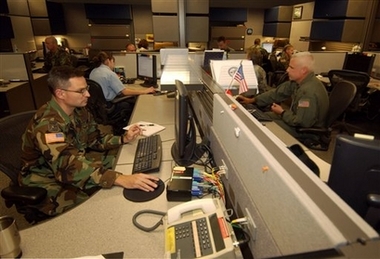 Unidentified analysts keep tabs on information flowing into the Combined Intelligence and Fusion Center for NORAD/Northcom in Colorado Springs, Colo., in this Aug. 25, 2004 file photo. [Agencies] |
The original concept behind fusion centers was to coordinate resources, expertise and information of intelligence agencies so the country could detect and prevent terrorist acts. The concept has been widely embraced, particularly by the Sept. 11 commission, and the federal government has provided $130 million to help get them off the ground. But until recently, there were no guidelines for setting up the centers and as a result, the information shared and how it is used varies.
Centers in Kansas and Rhode Island are the only two focused solely on counterterrorism. Other centers focus on all crimes, including drugs and gangs, said the GAO, Congress' investigative and auditing arm. Washington state's fusion center, for instance, has an all-hazards mission so it can focus on natural disasters and public health epidemics in addition to terrorism.
"States are at different levels because there wasn't the preconceived game-plan on how to do this," said George Foresman, a former undersecretary at the Homeland Security Department who oversaw the awarding of startup money for many of the centers.
The GAO findings backed up results from a congressional report earlier this year.
"Although many of the centers initially had purely counterterrorism goals, for numerous reasons they have increasingly gravitated toward an all-crimes and even broader all-hazards approach," according to a June Congressional Research Service report.
Most of the centers are run by state police or other law enforcement agencies, but many also have representatives from a wide range of other agencies, including fire and public works departments and state gambling regulators. This has raised concerns about privacy as those agencies become linked to a broader intelligence-sharing network. Most of the centers also include federal officials such as analysts from the FBI and the Homeland Security Department.
Some centers are even housed together with federal agencies, which can be a benefit. Minnesota's fusion center, for example, is in the same building as the FBI, which makes it easier for local officials to access the FBI's networks.


|
|
|
||
|
||
|
|
|
|