Watch it, Tom! Experts find fearless Jerries
Updated: 2007-11-10 10:57
Fear may be linked to the sense of smell, and can be switched off simply by shutting down certain receptors in the brain, Japanese scientists have found.
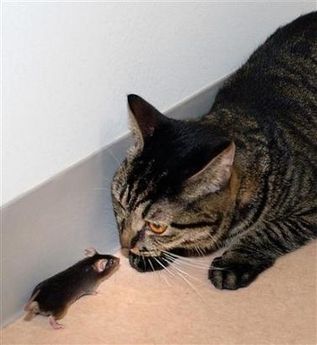 An undated handout photo shows a cat and a brown mouse within an inch of each other. Fear may be linked to the sense of smell, and can be switched off simply by shutting down certain receptors in the brain, Japanese scientists have found. [Agencies] |
In an experiment with mice, the researchers identified and removed certain receptors on the olfactory bulb of their brains -- and the result was a batch of fearless rodents.
To prove their point, the scientists showed pictures of a brown mouse within an inch of a cat, sniffing up its ear, kissing it and playing with its predator's collar.
"They detect the smell of predators ... like a cat and urine of a fox or snow leopard, but they don't display any fear. They even show very strong curiosity but they can't tell the smell is a sign of danger," said Hitoshi Sakano at the University of Tokyo's department of biophysics and biochemistry.
"So these mice are very happy with cats. They play with cats. But before taking the picture, we had to feed the cat," he said.
Experts have long thought that fear in animals may be prompted by their keen sense of smell.
But this is the first time scientists have discovered that smell detection and how that translates to fear take place in different parts of the olfactory bulb.
"How do our brains interpret the odorous information? What we found is that in the mammalian system, there are two circuits, one is innate and one is associative learning for detecting smells," Sakano said.
Sakano and his colleagues created two lines of mice -- one lacking the receptors to translate odors and the other lacking receptors for smell detection. They were then exposed to the urine of predators such as snow leopards and foxes.
"(The first group) keeps smelling and they turn around and they show very strong curiosity but they never can tell any danger," Sakano said.
As for the second group, Sakano said: "They are very poor in detecting smell, but as soon as they detect the fox urine, they would freeze and they will pretend to be dead.
"They are very poor in detecting smell, discriminating them and associating their memory with detecting information. They are very slow. But when they do, they can immediately tell the danger."
Mice have about 1,000 smell receptor genes, while humans have only 400 functioning ones and about 800 non-active ones, he said.
"Our sense of smell in us is bad. We can't detect this year's wine from last year's," he said.
|
|
|
||
|
||
|
|
|
|